If you have a habit to stand nearby your window early morning, you might notice that soon the Sun will start moving towards the Southern direction. Sun will enter in the Cancer and now moon will have an upper hand. This event is Dakshinayan. Yes, something opposite to Utarayana but not much discussed. This is as important as an event as is- Utarayana.
Aacharya Charaka says- दक्षिणाभिमुखेऽर्के कालमार्गमेघवातवर्षाभिहतप्रतापे - the wind, earth, clouds, rain all together weakens the strength of the Sun overall and its impact goes milder. Therefore the opposite, the Moon gains strength- "शशिनि चाव्याहतबले". Rainy water and strength of the Moon altogether cools down the mother nature and mother nature starts rebuilding after a scorching times of heat-waves.
Vedic literature emphasises on the movements of Moon and Sun and this movement from North to South and vice-versa is not alone important, the main is change of Rashis by the Sun overall.
The Southern Quadrant have three Ritus. Varsha, Sharad and Hemanta- "loosely" represents- rain, autumn (fall) and early winter. The colder half of the year.
Now we are standing on the doors of this celestial event of Dakshinayana - which will take place on Thursday, July 16, 2026. This is the start of the Varsha Ritu and from this particular event onwards for next one year we will discuss the Seasonal regime as per Ayurveda. In last 20 years of clinical practices, I have witnessed the movement of Doshas- physiologically as well as pathologically and witnessed the morphing of health based on these movements.
What the body remembers that the mind forgets
There is something interesting about human beings. We adapt. We switch on air conditioners, we eat mangoes in December and we override every seasonal signal our body sends. And then we wonder why we fall sick.
The body, however, does not forget. It never has.
Every monsoon, without fail, I see the same patterns in my OPD. A patient with Ankylosing Spondylitis calls to say the morning stiffness has returned. Someone managing Avascular Necrosis for two years reports that the hip ache woke them at 3 AM. A patient who was doing beautifully through summer arrives looking pale and bloated, digestion suddenly sluggish. These are not coincidences. These are the Doshas moving — exactly as Aacharya Charaka described them two thousand years ago.
This is not superstition. This is observation recorded so precisely that it holds good today, in the twenty-first century, in a city like Jaipur where the monsoon hits with its full force every year without exception.
So let us understand what is actually happening — in the sky, in the body and in the clinic.
The Dosha movement in Varsha Ritu- and why it matters more than you think
Ayurveda describes a cyclical movement of Doshas across the year. Sanchaya, Prakopa, Prashamana — accumulation, aggravation, pacification. These are not vague philosophical terms. They are clinical stages. And Varsha Ritu is where one of the most significant of these movements takes place.
During the dry, scorching months of Grishma Ritu- summer- Vata accumulates quietly. The heat dries everything it touches. The earth cracks. The body too, in its own way, begins to dry out — joints, channels, tissues. Vata, which is dry, light, mobile and cold by nature, finds the perfect environment to build up.
Now the rains come.
The clouds block the Sun.
The earth becomes damp.
The temperature drops.
And suddenly that accumulated Vata is provoked — Prakopa.
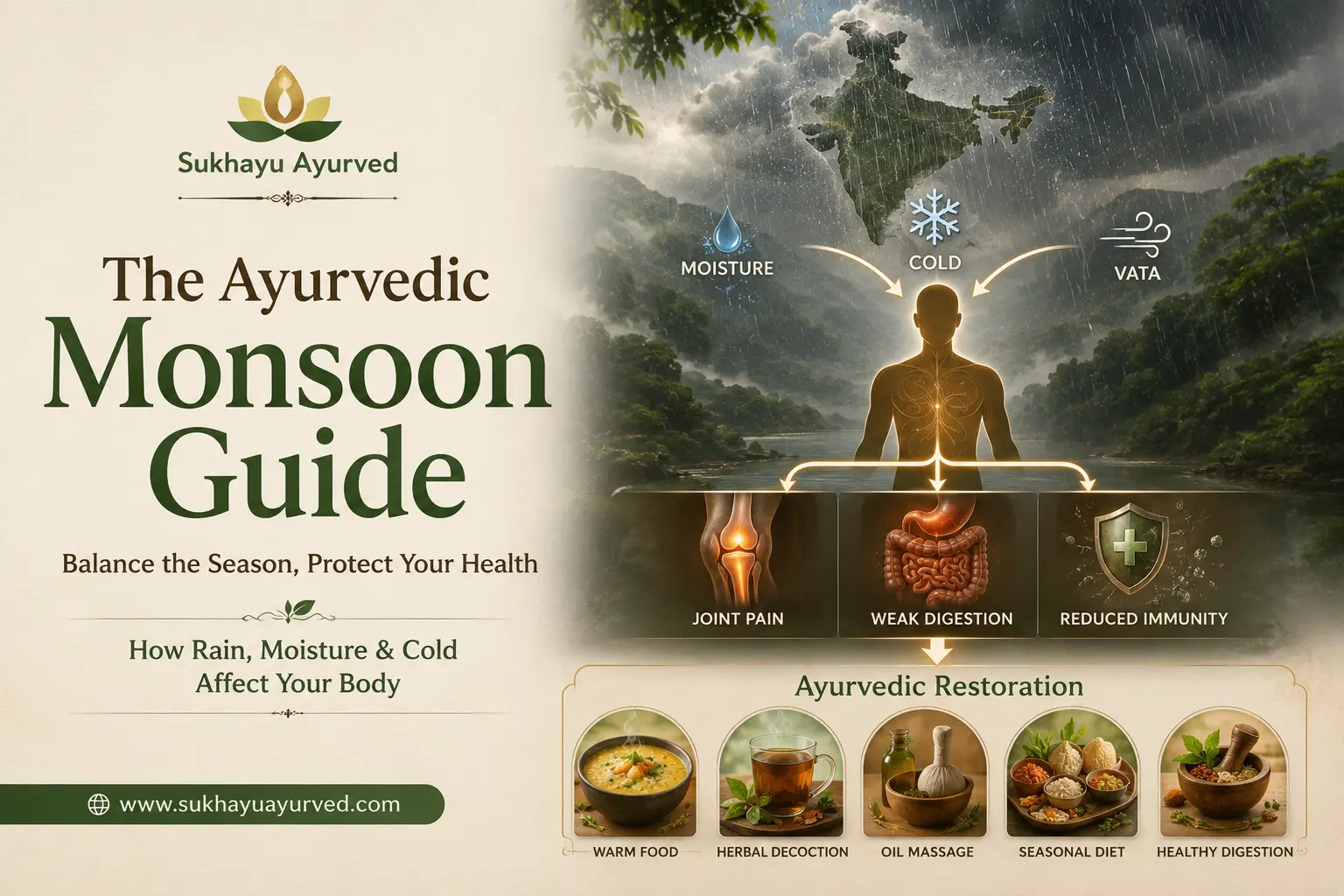
It spills over from its seat in the large intestine and begins to travel. This is the moment when patients with joint conditions feel the shift. This is when neurological symptoms flicker. This is when digestion, already weakened by the seasonal transition, begins to struggle.
Aacharya Charaka describes this state with characteristic precision: the Agni — the digestive fire — becomes vishamavat. Unsteady. Unpredictable. One day you eat the same food you have eaten for years and feel perfectly fine. The next day the same meal leaves you bloated and uncomfortable by evening. This is not a food problem. This is a fire problem.
At the same time, Pitta — which had been accumulating through the summer heat — has not yet been fully pacified. The monsoon cools the outside world but the internal heat lingers. This is why many patients experience both sluggish digestion and acidity simultaneously during this season. The system is caught between a provoked Vata and a simmering Pitta. A difficult combination to manage, and one that requires a careful hand.
Joint pain in monsoon — the clinical reality
Let me be direct about something I have observed consistently across two decades of practice.
Monsoon does not cause joint disease. But it reveals it.
If Vata is already vitiated - as it is in conditions like Ankylosing Spondylitis, Avascular Necrosis, Rheumatoid Arthritis, or simply from years of poor lifestyle - the Prakopa of Varsha Ritu acts like a stress test on a bridge that already has a crack. The crack was always there. The monsoon simply makes it visible.
This is why I am always cautious when a patient says, "Doctor, I was perfectly fine and then the rains came and everything went wrong." The rains did not create the problem. They exposed what was building beneath the surface.
From an Ayurvedic standpoint, the aggravated Vata in this season travels through the Srotas — the channels — and settles in the joints. The Sanskrit term for this is Shleshaka Kapha Kshaya — a depletion of the lubricating Kapha in the joints, combined with an excess of Vata. The result is what every patient describes: stiffness, cracking sounds, aching that is worse at rest and better with gentle movement, pain that peaks in the early morning and late evening.
This is not the same as inflammatory arthritis, though the two can coexist. Understanding the difference is the beginning of treatment.
Digestion in Varsha Ritu- the fire that needs tending
If there is one thing you take from this article, let it be this — protect your Agni this monsoon.
The Vishama Agni of Varsha Ritu is its defining feature. And weak digestion in Ayurveda is never just a stomach problem. Charaka Samhita is emphatic: रोगा सर्वेपि मंदाग्नौ — all diseases begin from impaired digestion. When Agni weakens, Aam forms. And Aam — that sticky, unprocessed metabolic residue — is the root of inflammation, heaviness, fatigue, and over time, of deeper pathologies.
In practical terms, patients during monsoon often notice that they crave hot, fried, spicy food — the body is trying to compensate for the weakened fire. But indulging those cravings makes things worse. The very foods that seem appealing become the fuel that creates more Aam.
What the Vishama Agni actually needs is not stimulation through excess but steadiness through simplicity.
Here is what I recommend to my patients for the monsoon months without exception:
Eat freshly cooked, warm food.
Cold food and refrigerated leftovers are difficult for a healthy Agni on its best day. In monsoon, they are counterproductive. The Agni cannot process what it cannot warm.
Keep meals light.
This is not the season for feasting. Soups, khichdi, moong dal — these are not simple foods. They are the most intelligent foods for this season. They nourish without burdening.
Use digestive spices generously.
Ginger, cumin, ajwain, black pepper, hing — these are your Agni's allies. A small piece of fresh ginger with rock salt before a meal is one of the simplest and most effective Ayurvedic practices for monsoon. It kindles the fire before you add the fuel.
Avoid raw food, cold drinks and heavy dairy.
Curd in particular — despite being beloved across Indian households — is specifically contraindicated in the classical texts for monsoon evenings. The timing matters as much as the food itself.
Do not skip meals.
A Vishama Agni that is left empty for too long becomes more erratic, not less. Eat at consistent times, even if you are eating less.
Immunity in Varsha Ritu - why you fall sick and why Ayurveda predicted it
The monsoon surge in infections — viral fevers, colds, coughs, fungal skin conditions, waterborne illnesses — is something modern medicine explains through the proliferation of pathogens in humid conditions.
That explanation is correct.
But it is incomplete.
Ayurveda adds another layer.
The Bala- the strength and immunity of the body- is at its annual low point during Varsha Ritu.
After the depleting heat of summer and now with the destabilised Doshas of monsoon, the body's resistance is genuinely diminished. This is not weakness. This is a predictable physiological phase that the Acharyas built an entire seasonal protocol around.
The concept of Ritucharya- seasonal regimen - is precisely the answer to this vulnerability. It exists not because Ayurveda is cautious but because the ancients understood that the body requires different support at different times of the year. A monsoon immune system cannot be managed the same way as a winter immune system.
Rasayana herbs become especially important here. Ashwagandha, Guduchi, Haritaki, Amalaki- these are not generic immunity boosters the way the wellness market has packaged them. In Varsha Ritu, they serve a specific function: stabilising Agni, clearing Aam, and replenishing Ojas — the finest essence of immunity that gets depleted through summer.
Panchakarma in monsoon- the season of deep healing
There is a reason the classical Ayurvedic texts single out Varsha Ritu as the ideal season for Panchakarma. Not summer. Not winter. The rains.
The logic is precise. When the pores of the skin are open due to humidity, when the channels of the body are soft and receptive, when Vata is active and moving — this is when therapeutic intervention penetrates deepest. This is when medicated oils enter the tissue. This is when Basti — the Panchakarma treatment considered the most powerful for Vata disorders — achieves its fullest effect.
I have seen patients who underwent Panchakarma in summer with moderate results return for a course during monsoon and experience a depth of improvement that surprised even them. The season is not incidental. It is part of the treatment.
If you have been considering Panchakarma for a chronic joint condition, for neurological support, for an autoimmune diagnosis that has been dragging on — this is the window. The body is prepared. The season is cooperating.
The Ritucharya for Varsha Ritu- what to actually do
Let me make this practical. The following guidelines are drawn directly from classical texts and adapted for the reality I see in my OPD every July and August.
- Abhyanga daily. Self-oil massage with warm sesame oil before your bath is not a luxury in this season. It is a necessity. Vata is aggravated, the skin is a site of Vata expression, and daily oil application is the most consistent tool to keep it pacified.
- Avoid river water and stagnant water exposure. The texts are specific about this, and modern sanitation science agrees. Waterborne infections spike in monsoon precisely because water quality deteriorates.
- Sleep rhythm matters more than usual. Avoid sleeping during the day — it increases Kapha and Aam formation, already tendencies of the season. Keep consistent bedtimes. The body's internal clock is being tested by shorter, cloud-covered days.
- Exercise moderately. This is not the season for intense training. The body's Bala is lower. Half capacity, as the texts say — Ardha Shakti. Gentle yoga, slow walks, pranayama. Not competitive sport or heavy weight training.
- Wear clean, dry clothes. A simple instruction that the monsoon makes genuinely difficult. Dampness on the skin prolongs Kapha accumulation and invites fungal conditions. The effort is worth making.
- Nasya. Applying a few drops of warm sesame oil or Anu Taila into the nostrils in the morning — before stepping outside — protects the respiratory passage from airborne infections and seasonal allergens. It takes thirty seconds and the benefit is measurable.
The 20 years behind this article
I want to close with something personal.
Every year, around mid-July, there is a shift in the quality of patients who walk into my clinic. The summer patients come with heat-related complaints, inflammatory flares, skin issues. And then, with an almost clockwork precision that still impresses me after two decades, the monsoon patients begin arriving. The joint pain cases. The sluggish digestion. The recurrent viral fevers. The autoimmune flares.
And every year, without exception, those patients who had followed a Ritucharya — who had made even small adjustments in diet, oil application and sleep — came in for a check-up rather than a crisis.
This is the quiet power of Ayurveda. Not dramatic intervention after the body has broken down. But a steady, seasonal intelligence that keeps the body from breaking down in the first place.
Dakshinayana has begun. The Moon has strength. The earth is cooling. The body is asking for something different from what it needed three months ago.
Are you listening?
Dr. Pardeep Sharma, M.D. (Ayurveda) is the founder of Sukhayu Ayurved, Jaipur. With over 20 years of clinical experience in the Ayurvedic management of orthopedic, neurological and autoimmune conditions, he writes on seasonal health, clinical Ayurveda and the science behind traditional protocols.