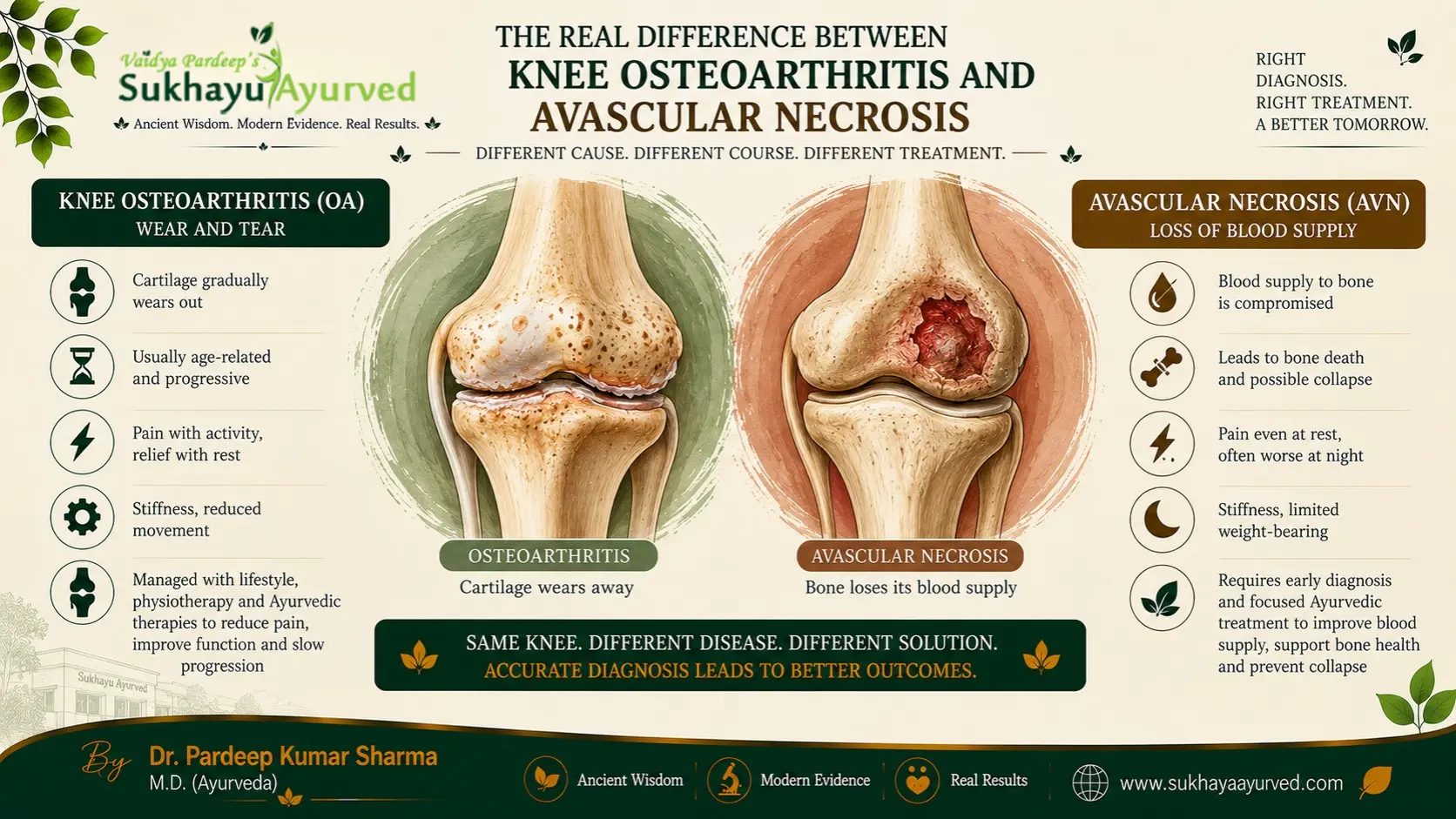
Two patients walk into the clinic in the same week. Both have a knee that hurts. Both have been told, somewhere along the way, that it is "wear and tear" and that a replacement is only a matter of time. On the surface, their stories look identical.
They are not the same disease. They are not even close.
One has osteoarthritis. The other has avascular necrosis. And the single most important thing I can do for either of them is not to prescribe a therapy on day one — it is to tell them, honestly, which of these two diseases they actually have. Because everything that follows — what treatment can achieve, how long it takes, whether the joint can be saved — hangs on that distinction.
This article is about that distinction. Not to alarm you, but to give you the one piece of understanding that most patients are never handed: the joint surface is where you feel the pain, but it is almost never where the disease begins. The disease begins below it, in the bone. And in these two conditions, the bone is failing for opposite reasons.
First, forget "wear and tear"
For fifty years, osteoarthritis was described as a cartilage-wear disease — as if the joint were a machine part that simply rubbed itself thin. That picture is now considered incomplete, and it matters that you know why.
Your bone is not a static stone that, once formed, stays fixed for life. It is living tissue, rebuilt continuously — every single day. Two kinds of cells do this work. Osteoclasts break down old, worn bone: the demolition crew. Osteoblasts lay down fresh bone: the construction crew. In a healthy joint, these two are held in careful balance by the body's own signalling system.
Health, in bone, is this balance. Disease begins when the balance breaks. And here is where our two conditions split apart — because they break it in completely different ways.
Knee osteoarthritis: a problem of balance
In osteoarthritis of the knee, the trouble is in that build-and-break balance itself.
Early on, the demolition crew works overtime. The bone just beneath the cartilage — the subchondral bone — starts being resorbed faster than it is replaced. It grows porous. On an MRI, this is the phase where bone marrow lesions appear, and much of the early pain a patient feels is coming not from the cartilage at all, but from this disturbed bone underneath.
Then, as the disease settles into its later course, the pendulum swings the other way. Now the construction crew overcompensates. Too much bone gets laid down — the subchondral bone becomes hard and thickened (sclerosis), and bony outgrowths (osteophytes, or bone spurs) form at the joint margins. But here is the paradox that tells you how strange this disease is: this new bone is denser yet weaker. It is poorly organised and poorly mineralised — thick to look at, but not sound.
And the damage does not stay below. Tiny cracks and new blood vessels breach the boundary between bone and cartilage, and signals from the disturbed bone cross over and accelerate the breakdown of the cartilage above. This is why osteoarthritis is now understood as a whole-joint disease — not a cartilage problem with the bone as a bystander, but a disease in which the bone is an active participant, sometimes the driver.
In short: in osteoarthritis, the building crew and the demolition crew have lost their coordination. The supply lines are intact. The workers are simply out of balance.
Avascular necrosis: a problem of supply
Avascular necrosis — also called osteonecrosis — is a fundamentally different failure. Here, the crews are not the problem. The supply line is cut.
In AVN, the blood supply to a segment of bone is obstructed. Deprived of circulation, that patch of bone tissue dies. The bone weakens, and in advanced cases the joint surface above it collapses — after which secondary osteoarthritis sets in on top of the original necrosis. The femoral head of the hip is the most common site; the knee is the next.
Notice the sequence, because it is the whole point: the necrosis is not the disease. It is the result of the disease. The bone dies because its nutritional supply — and its drainage — has been cut off. Once you understand AVN as a blocked-circulation problem rather than a worn-tissue problem, the entire logic of treatment changes. The goal is not to manage dead bone. It is to restore what is actually failing: the blood supply feeding it.
This is also why AVN is so often missed for months. Early on, patients assume the ache is a muscle spasm. As it progresses, it starts to mimic sciatica — and a great many AVN cases are not correctly identified until the disease has already advanced. The tell is in the pain: AVN pain is deep and often worsens at night and at rest, and it stays confined to the hip, groin, and knee rather than shooting down the leg past the knee the way true sciatica does. A hip that hurts more lying down at night, with pain that does not travel below the knee, is a hip that should be imaged for AVN rather than assumed to be a spinal problem.
How Ayurveda reads the two — and why it reads them differently
The classical framework maps these two diseases with a precision that lines up remarkably well with the modern mechanisms.
AVN is Vatashonita — a condition Acharya Charaka describes with unusual exactness. Aggravated Vata, obstructed in its passage by vitiated Rakta (blood), goes on to corrupt that Rakta further: a self-reinforcing loop of obstructed circulation and trapped, aggravated Vata. Mechanistically, it is a Sanga — an obstruction — within the Raktavaha Srotas, the channels carrying blood to the tissue. When the channel is blocked (by fat emboli in steroid- and alcohol-related cases, by abnormal blood in sickle-cell disease, or physically by an implant), the bone beyond the blockage is cut off from nourishing blood and decays. Tellingly, this is one of the very few conditions in the classical texts where actual tissue necrosis is described as part of the disease — Charaka understood this was something distinct from ordinary joint disease. The response the texts indicate is not detoxification but the clearing of the obstruction and the pacification of the trapped Vata.
Osteoarthritis is read differently, precisely because its failure is one of balance and degeneration in the joint as a whole rather than a blocked blood channel feeding a dying segment of bone. Treating the two as the same disease — which is effectively what "it's all just wear and tear, let's replace it" does — is the error this whole article exists to correct.
One disease is a supply-line failure. The other is a balance failure. An honest physician has to know which one is in front of them before saying a single word about outcome.
Why the distinction changes everything about treatment
Here is where the difference stops being academic and starts deciding your options.
In AVN, stage is everything. AVN is staged — most commonly on the Ficat–Arlet system — and the line that matters runs between pre-collapse and post-collapse. Before the femoral head collapses, the bone's architecture is still substantially intact, and there is real, MRI-documented room to work on restoring the blood supply and arresting progression. After major collapse — when the joint surface has flattened, joint space is largely gone, and bone marrow edema is severe — no treatment, Ayurvedic or surgical-alternative, restores the original architecture, and surgery becomes the responsible path. The deciding factor is not hope. It is what your imaging actually shows. This is why, at our clinic, the first and most useful step is having your existing MRI read against these specific criteria rather than guessing which side of that line you fall on.
In osteoarthritis, the whole-joint picture is everything. Because the disease is one of balance and involves the entire joint — bone, cartilage, the surrounding tissue and its circulation — treating only the pain leaves the underlying process untouched. Pain is information: it tells us something inside is still not right. Suppressing it and addressing it are not the same thing.
There is one more difference worth stating plainly, because it surprises patients and it is important for safety. In osteoarthritis, guided movement generally helps. In AVN, indiscriminate movement of the affected joint can actively harm it — a necrosed, roughened femoral head grinding under load against the smooth cartilage of the socket can cause damage that was not there before. "Exercise for the joint" is sound advice for one of these diseases and potentially harmful advice for the other. That alone should tell you why the diagnosis has to come first.
What this means for you
If you have been told your knee or hip is "just wear and tear" and that replacement is inevitable, the honest question to ask is not which treatment — it is which disease, and at what stage.
Both osteoarthritis and avascular necrosis are diseases of the bone beneath the joint, not simply of the joint surface. But one is a failure of balance and the other a failure of supply, and that difference decides what is realistically possible. In early, structurally intact disease — of either kind — there is often a genuine, physiologically grounded path that is not surgery. In late, collapsed, end-stage disease, the responsible answer changes, and any physician who tells you otherwise is not being straight with you.
Ayurvedic treatment here is complementary to your conventional care, not a replacement for it — and any decision to change or taper a prescribed medication belongs to the physician who prescribed it, not to an article. What we can offer is to look at what your imaging actually shows, tell you plainly which disease and which stage you are dealing with, and give you a direct answer on whether a non-surgical path is realistic in your specific case.
Because cure is divine. Treatment is possible. And the first step in any real treatment is an honest diagnosis.