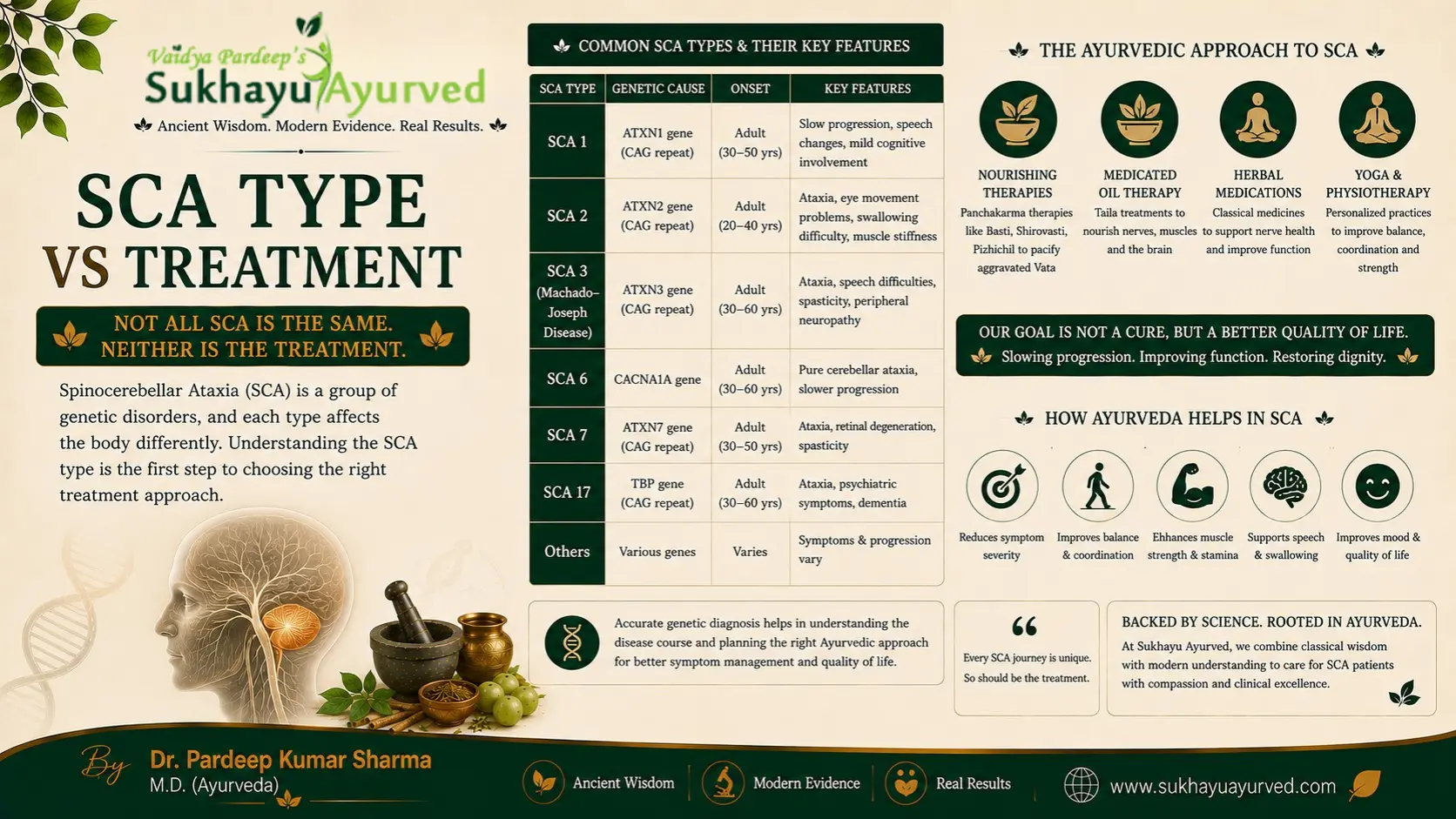
There is a particular kind of patient who walks into the consulting room already holding the answer they came to disprove. They have read everything. They can recite their CAG repeat count. They know that they are SCA6 and not SCA2, SCA1 and not SCA12, and somewhere in that knowing, a door has quietly closed. Because if they are a type, then surely there must be a treatment for that type — a specific key cut for a specific lock — and every conversation that does not produce that exact key feels like a conversation that has missed the point.
I want to gently take that certainty apart, because it is costing patients the one thing they cannot afford to lose: the wider view.
The fracture that taught me how to talk about type
Think about a fractured bone.
Where the fracture happens changes real things. A fracture at the neck of the femur is fixed differently from one at the shaft. The surgeon chooses a different implant, a different approach, a different rehabilitation. The site genuinely dictates the method of fixation.
But notice what does not change. The bone still needs to be brought into alignment. The blood supply still has to be respected. The tissue still has to be given the conditions under which bone knits to bone. The basics of the treatment plan — reduction, stability, the biology of healing — are shared across every fracture, whatever its location. No orthopaedic surgeon has ever told a patient, "Because your fracture is at the neck and not the shaft, you belong to a different category of human being whose bones heal by different laws."
Spinocerebellar ataxia is exactly this. The type is the site of the fracture. It is not a different disease with different laws.
The one bone under all the numbers
Strip away the subtype labels and look at what every SCA is actually doing, underneath.
The overall pathology of spinocerebellar ataxia follows a single shared trajectory. An inherited genetic mutation sets off chronic cellular stress inside the neuron. That sustained stress culminates in the selective degeneration of Purkinje cells — the great output neurons of the cerebellum — and, over time, in the structural atrophy of the central nervous system. Mutation, stress, Purkinje loss, atrophy. That chain is the bone. It is common to SCA1, SCA2, SCA6, SCA12, and their siblings.
So where does the number come from — why does an SCA6 patient present differently from an SCA2 patient, if the trajectory is shared?
The demarcation is at the cellular level, in the region. Different subtypes carry their Purkinje cell loss into somewhat different territories of the cerebellum and its connections. SCA6 is the cleanest illustration: in this subtype the neuronal degeneration is confined largely to the cerebellar Purkinje cells, with little involvement of other central nervous system structures — which is why it is regarded in the neurological literature as the prototype of a pure cerebellar ataxia.¹ ² Other subtypes let the same degeneration spill further — into the brainstem, the extrapyramidal system, the peripheral nerves — and that spillage is what colours the clinical picture.
Different site. Different representation. Same fracture, in a different place on the same bone.
This is the whole argument, and it is worth sitting with: your type does not tell the physician what your disease is. Every SCA physician already knows what it is. Your type tells the physician where it is concentrated — which changes emphasis, not essence.
What Ayurveda sees underneath the ataxia
The classical view arrives at the same shared root by its own road, and I find the convergence striking.
At Sukhayu, Ayurveda recognises all movement-related conditions as Vata Vyadhi, because Vata is the principle responsible for coordination — and coordination is precisely what fails in spinocerebellar ataxia. But the reading goes deeper than "aggravated Vata." Spinocerebellar ataxia is, more specifically, a condition of Kaphavrita Vata — Vata obstructed and enveloped by Kapha — unfolding against a background of Majja Dhatu Kshaya, the depletion of the nervous tissue itself. That single description already tells you why these diseases degenerate and yet also stiffen and grow heavy — why the picture is not pure wasting but wasting overlaid with obstruction.
Two vayus carry the burden of this presentation. Vyana Vata governs circulation and the distribution of movement across the whole body — the coordinated locomotor output that lets a person walk a straight line, reach accurately, hold a posture. Udana Vata governs speech, effort, vitality, and all the upward functions of the body. When Kapha envelops each of these, the classical texts describe a specific symptom-set — and it is here that the old language and the modern clinic turn out to be describing the same patient.
Reading the avarana in two languages
Watch what happens when the classical avarana symptoms are laid beside the neurological phenotypes. This is the part I most want SCA patients — and their physicians — to understand, because it is where "type" finally finds its correct, modest place.
Kapha-avrita Udana produces heaviness, weakness, and above all vak-svara-graha — the seizing-up of voice and speech — accompanied by aruci and vaivarnya, the loss of taste and of natural complexion. Read in modern terms, this maps onto a bulbar and phonatory phenotype: prominent dysarthria, dysphagia, a weak or altered voice, reduced speech effort, progressive weakness. This is why Udana involvement becomes evident precisely where these features dominate — as in SCA1, which is characterised by ataxia, dysarthria and progressive deterioration of bulbar function as the disease advances,³ ⁴ and in advanced SCA3. Udana tells us about the loss of expression — voice, swallowing, effort, strength.
Kapha-avrita Vyana produces heaviness, joint and bone pain, and above all gati-sanga — the obstruction of movement itself. Read in modern terms, this maps onto a motor-execution, akinetic-rigid phenotype: bradykinesia, rigidity, reduced spontaneous movement, difficulty initiating movement, a general restriction of motor freedom. This is why Vyana involvement declares itself in the parkinsonian presentations of SCA — recognised especially in SCA2 and SCA3, where levodopa-responsive tremor, bradykinesia and rigidity can be a prominent or even presenting manifestation.⁵ ⁶ Vyana tells us about the loss of execution — initiation, distribution, and freedom of movement.
In SCA2 and SCA3, both patterns may coexist, because these disorders can involve the cerebellar, bulbar, and extrapyramidal systems at once. That is not a contradiction; it is what a fracture looks like when it runs across more than one region.
Now the guardrail, because this is where lesser writing overreaches and I will not. These avarana patterns are functional correlations, not anatomical equivalences. Kapha-avrita Udana is not a synonym for a brainstem lesion; Kapha-avrita Vyana is not a code for a basal-ganglia lesion. They are the classical way of reading how the patient's functions are failing, and they should be used to guide the emphasis of treatment — never to relabel a scan.
And SCA6 is the proof that this restraint matters. SCA6 is a relatively pure cerebellar ataxia. A patient with SCA6 will have gait ataxia, and often dysarthria — and yet it would be an error to file them automatically under Udana-avarana or Vyana-avarana merely because those symptoms are present. The avarana pattern is diagnosed from the whole functional picture and its dominant obstruction, not from the presence of any single sign. Dysarthria alone does not summon Udana. Gait ataxia alone does not summon Vyana. The physician reads the person, not the symptom in isolation.
A note on the science. The correlations above are drawn deliberately, function to function, and they hold against the neurological literature. SCA1 is characterised by ataxia, dysarthria and progressive bulbar dysfunction (GeneReviews, NCBI, 2023; Zoghbi & Orr). Akinetic-rigid, levodopa-responsive parkinsonism is a recognised and sometimes dominant phenotype in SCA2 and SCA3 / Machado-Joseph disease (JAMA Neurology 2004; Neurological Sciences, Springer 2023; Frontiers in Neurology 2025). SCA6's degeneration is confined largely to cerebellar Purkinje cells, making it the prototype of pure cerebellar ataxia (Acta Neuropathologica, Sasaki et al. 1998; Handbook of Clinical Neurology). The Ayurvedic reading does not compete with this evidence — it organises it around function, which is what treatment actually acts upon.
Why the "type" trap is so seductive — and so costly
I understand exactly why patients grip their number so tightly. When a disease is frightening and progressive, a specific label feels like control. It feels like knowledge. It feels like the beginning of a search that ends in a bespoke cure meant only for people like you.
But watch what the grip actually does. It narrows the vision to a slit. The patient stops asking the large, correct questions — which of my functions is obstructed, how is my Vyana and my Udana faring, what can genuinely be done to slow and support this process? — and starts asking a small, unanswerable one: what is the treatment for SCA6, specifically, that an SCA2 patient is not allowed to have?
That treatment does not exist, because that is not how the disease is built. And in waiting for a key that was never cut, the patient discards the broader picture — the one place where real, patient-specific, root-directed work actually happens.
An SCA6 patient is not a different sect. They are not a separate species of the ill. They are a person whose fracture sits in one region of a bone that every other SCA patient also carries.
What this means for treatment
If the disease is one shared samprapti wearing different regional masks, then the treatment cannot be a catalogue of type-specific packages. It has to address the root that every mask hangs on. This is exactly how Ayurvedic treatment for spinocerebellar ataxia at Sukhayu is built.
The governing strategy is Samtarpana Chikitsa — nourishing therapy — because in this condition the body decays internally at a high pace, and nourishment is what brings it back toward normalcy. But nourishment is disciplined by two rules that come straight from the nature of Vata, and getting them wrong makes the disease worse rather than better:
- Vata itself drives decay, so degeneration under aggravated Vata always runs on the higher side, and the progress of the disease is genuinely hard to arrest. The treatment respects how formidable that is.
- Pacifying Vata must never mean suppressing Vata. The treatment cannot work against the character of Vata — Vata is also the principle of movement and life. So the aim is to nourish and re-harmonise, not to sedate the very force we are trying to restore.
There is a third discipline layered on top, and it connects directly to the Kapha side of Kaphavrita Vata: while nourishing heavily, the patient's Kapha must not be allowed to climb past a point, because that tips into weight gain and worsened walking — the obstruction deepening rather than lifting. Nourish the Vata-Majja deficit; do not feed the Kapha avarana. That balance is the art of the treatment.
Clinically this is delivered as a staged Panchakarma sequence rather than a single admission — four sessions, structured roughly as a 21-day first session, then 15 days, 15 days, and 8 days, with intervals of two to three months between them, and internal Rasayana medicines continuing across 24–36 months in younger patients (longer in older patients). The specific therapies are chosen to meet your dominant avarana — and this is where the type genuinely earns its keep. Where the picture is Udana-dominant (the bulbar, speech-and-swallow presentation), the emphasis shifts toward therapies that open the head and upward channels — Nasya foremost, supported by Shirodhara for Udana's stability. Where the picture is Vyana-dominant (the motor-execution, rigid presentation), the emphasis shifts toward Basti — the cornerstone of Vata management — with Pinda Sweda for limb coordination and tone. Basti in a nourishing (Karma Basti) format anchors the neurodegenerative protocol whichever way the picture leans, because it addresses Vata at its root seat.
You can see this logic playing out in real admissions rather than in theory. In one 21-day patient journey documented at Sukhayu, a young woman whose SCA had reduced her to needing help to walk and struggling to speak was treated with exactly this Nasya–Shirodhara–Pinda Sweda–Basti architecture, and her gait, speech coherence, balance, and sleep were tracked measurably across the three weeks before a six-month Rasayana protocol continued the work at home. A separate documented case followed a patient whose SARA score (the Scale for Assessment and Rating of Ataxia) was recorded before and after a staged protocol under direct physician supervision. These are individual documented cases, not guarantees — but they show the shape of what root-directed, avarana-led treatment actually does.
Notice what is not in any of this: a different disease-model for a different number. The type informed which therapies were emphasised and in what order. It did not fragment the diagnosis. We do not sell packages. We treat diagnoses. A package would be a fixed key for a fixed lock — the exact fantasy that keeps SCA patients waiting. A diagnosis-led approach reads your presentation, your dominant avarana, your regional picture, and molds the treatment to the person in front of us.
Two honest caveats belong here, because they are part of the treatment, not fine print. First, not every patient can be admitted — there are real inclusion and exclusion criteria, and they are assessed case by case before any commitment is made; the assessment is the treatment's first step, not a formality. Second, the diet and lifestyle discipline continues for life. Modern epigenetics and classical Prakriti arrive at the same conclusion: the gene alone does not decide everything — the food and lifestyle that trigger or restrain its expression matter, which is why the dietary and lifestyle restrictions are lifelong, not a 21-day event.
The one honest sentence I can offer
I will not tell you this is curable. Cure is divine; treatment is possible — and in a genetic, degenerative condition that sentence has to be said plainly, without the softening that the internet loves. The realistic and worthy aim is to stop the progress, protect function, and defend the quality of your life — because that is what changes a life here, and it is more than modern neurology alone currently offers for the degeneration itself.
But I can tell you that the door you think has closed is not closed. The moment you stop asking "what is the treatment for my number?" and start asking "which of my functions is obstructed, and what can be done for that, in my particular body?" — the picture widens again. And it is only in the wide picture, never in the slit, that anything worth doing gets done.
You are not your number. You are the person the number was only ever pointing at.
If you or someone you love is living with spinocerebellar ataxia, the right first step is a proper assessment rather than a package. You can book a consultation with the Vaidyas at Sukhayu here.
Spinocerebellar ataxia is a serious inherited neurological condition. Ayurvedic treatment is offered as complementary support alongside your ongoing neurological care, not as a replacement for it. Any change to your existing medications must be made only by your prescribing physician. Outcomes vary between individuals and are discussed as documented individual cases, never as guarantees.
References
- Sasaki H, et al. Neuropathological and molecular studies of spinocerebellar ataxia type 6 (SCA6). Acta Neuropathologica. 1998. — degeneration confined to cerebellar Purkinje cells without involvement of other CNS structures.
- Spinocerebellar ataxia type 6. Handbook of Clinical Neurology (ScienceDirect) — SCA6 as the prototype of a pure cerebellar ataxia; essentially pure cerebellar atrophy on MRI.
- Spinocerebellar Ataxia Type 1. GeneReviews®, NCBI Bookshelf, 2023 — SCA1 characterised by progressive cerebellar ataxia, dysarthria, and deterioration of bulbar function.
- Motor neuron degeneration and bulbar dysfunction in SCA1. PMC — progressive dysarthria and dysphagia as the disease advances.
- Parkinsonism in complex neurogenetic disorders (SCA2, SCA3). Neurological Sciences, Springer, 2023; and The Parkinsonian Phenotype of SCA2, JAMA Neurology, 2004 — levodopa-responsive rest tremor, bradykinesia and rigidity as prominent/presenting features.
- Spinocerebellar ataxias masquerading as movement disorders. Frontiers in Neurology, 2025 — akinetic-rigid parkinsonian phenotype in SCA2 and SCA3.