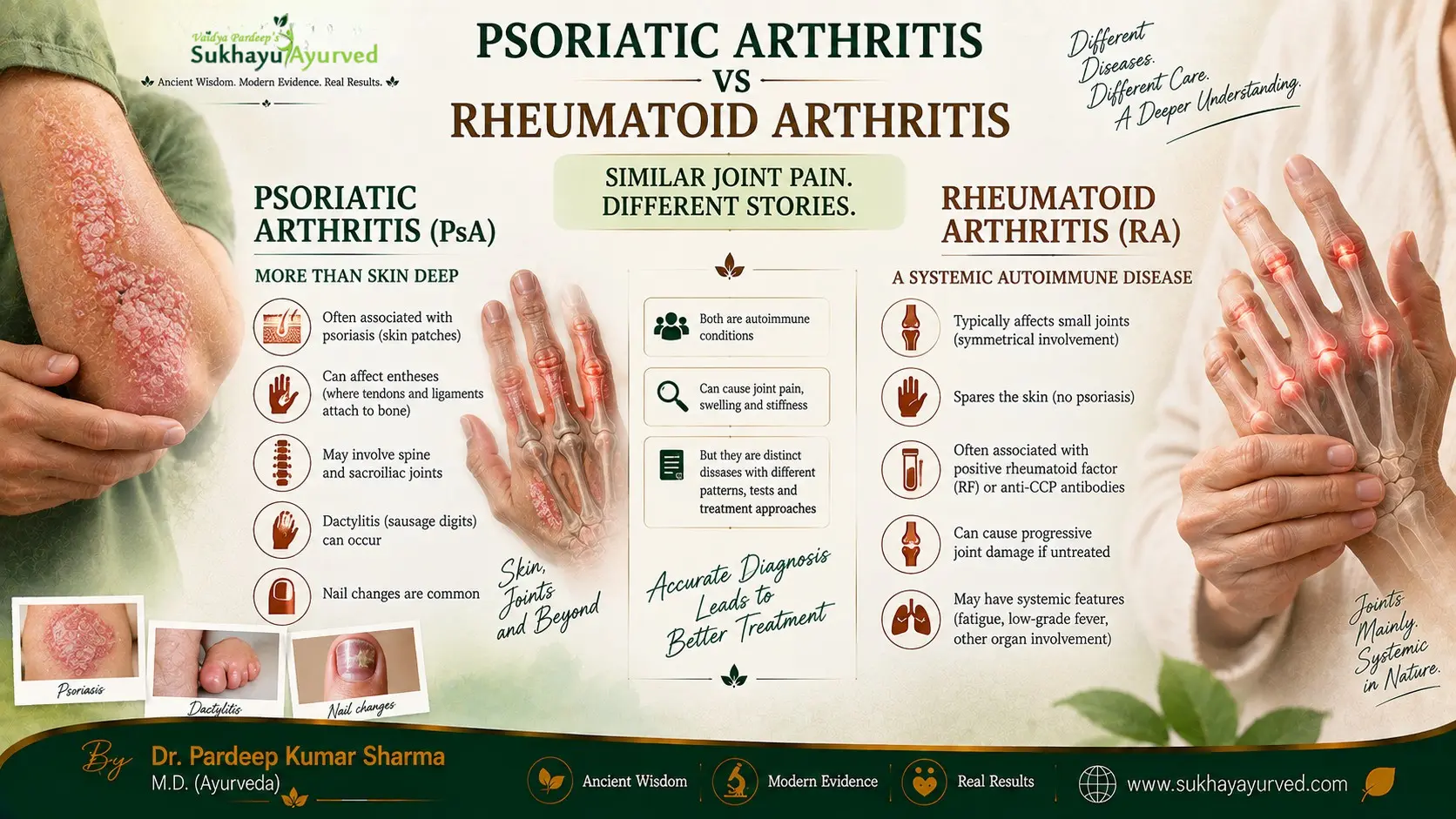
A patient sits down across from me with swollen fingers, morning stiffness, and a file. Sometimes the file already carries a label — rheumatoid arthritis — written by someone who saw a symmetrical polyarthritis and stopped there. Sometimes there is no label at all, only a negative RF report and a great deal of worry.
Both conditions inflame joints. Both can be symmetrical. Both cause morning stiffness. And yet, in Ayurvedic understanding, they are not two versions of the same disease. They begin in different places, travel by different routes, and require protocols that diverge almost completely.
This article explains how I separate them — first at the level of physical examination, then at the level of Ayurvedic classification, and finally at the level of treatment.
The examination comes before the report
Every laboratory report printed in this country carries the same three words at the bottom: correlate clinically. That instruction is not a formality. It is the honest admission that a test confirms a clinical diagnosis; it does not establish one.
So before I open the report, I look at the hands.
Joint distribution: the first divergence
The distribution of involved joints is the single most useful observation available without any investigation.
Rheumatoid arthritis classically spares the DIP joints — the small joints closest to the fingernails. It strongly prefers the proximal interphalangeal (PIP) joints, the metacarpophalangeal (MCP) joints, and the wrists.
Psoriatic arthritis frequently involves the DIP joints. When a patient has prominent small-joint inflammation right at the fingertips, the needle in my mind shifts immediately toward psoriatic arthritis, whatever the file says.
Looking for skin that the patient has not reported
Here is the trap. Up to 15% of patients with psoriatic arthritis develop the joint disease before visible skin psoriasis appears. Others have psoriasis so mild they have never thought to mention it.
So I do not ask "do you have psoriasis?" and accept a no. I look.
Nail changes come first: pitting, horizontal ridging, or lifting of the nail bed from its base (onycholysis). Nail involvement carries a substantial correlation with psoriatic arthritis — and the anatomical reason matters. The nail matrix is directly connected to the DIP joint. A nail change and a swollen fingertip joint are not two coincidental findings; they are the same process, seen at two depths.
Then I examine what I think of as the hidden triad — the sites patients almost never volunteer because they have long since normalised them:
- The scalp, where plaques are routinely dismissed as dandruff
- The umbilicus
- The gluteal cleft
- Behind the ears
A patient who has told three doctors they have no skin disease may have a plaque behind the ear that has been there for eleven years.
Symmetry and the spine
Rheumatoid arthritis is almost strictly symmetrical. Psoriatic arthritis can present symmetrically, but is traditionally asymmetric.
I also ask whether the morning stiffness extends into the back. Psoriatic arthritis can cause inflammatory axial disease — sacroiliitis or spondylitis. Rheumatoid arthritis characteristically spares the thoracolumbar spine, involving the cervical spine only in advanced disease. A patient with peripheral arthritis and genuine inflammatory back pain is telling me something important.
The genuinely ambiguous case — and what actually settles it
The cases that are hard in practice are not the textbook ones. The hard case is the seronegative patient with symmetrical small-joint involvement, no visible skin lesion, no nail change yet, and negative RF and anti-CCP.
In my caseload, there is rarely a single revelatory moment in these patients. What there is instead is a deliberate search for findings that break the rules of classical rheumatoid anatomy.
Two findings have proved most reliable:
- Asymmetrical dactylitis — the whole digit swollen, not the joint alone. The "sausage finger."
- Enthesitis at the insertion of the Achilles tendon or the plantar fascia — inflammation where tendon meets bone, which is a fundamentally different lesion from synovitis.
Enthesitis is the more telling of the two, because it points to a disease process that is not primarily synovial at all.
And I should name what has proved misleading, because a great deal of published content leans on exactly these:
- The strict pattern or duration of morning stiffness. It is quoted everywhere as a differentiator. In my experience it is not dependable enough to decide on.
- The subjective "feel" of the joint capsule on palpation. Experienced hands can convince themselves of a great deal here. I have learned not to weight it heavily.
If you have been told your stiffness lasted the wrong number of minutes to be one condition or the other, that reasoning is thinner than it sounds.
Why Ayurveda does not treat these as two kinds of arthritis
This is where the two conditions separate most sharply, and where most content conflates them.
Rheumatoid arthritis: a disease that begins at Agni
Rheumatoid arthritis begins as Agni Mandya — diminished digestive fire. From that impairment arises Ama, the incompletely metabolised residue the body can neither use nor clear. Ama becomes Ama Visha, and circulating with vitiated Vata it produces Sama Doshas — doshas carrying Ama with them.
The joint is not where this disease starts. The joint is where it settles. This is why the Amavata patient's history so often begins not with a joint complaint but with heaviness, poor appetite, and a coated tongue — and why seasonal aggravation follows the same logic, as I have written about in the context of monsoon flares in rheumatoid arthritis.
Psoriatic arthritis: Kushtha that has reached Majja Dhatu
Psoriatic arthritis is not, in my reading, an arthritis with a skin complication. It is Majja Dhatu Gata Kushtha — psoriasis that has penetrated to the level of Majja Dhatu.
That single classification reframes everything.
The joint involvement is not a separate disease that happened to appear alongside a skin disease. It is a depth-of-penetration finding. The Kushtha has moved inward through the dhatus and arrived at Majja. What we are calling arthritis is that arrival, expressed at the joint.
This also explains, in Ayurvedic terms, why the joint disease can appear before the skin disease is obvious. Depth of penetration and visible surface expression are not required to keep pace with each other.
Broadly — and I hold this as a tendency rather than an absolute — rheumatoid arthritis runs Kapha with Vata; psoriatic arthritis runs Pitta with Vata. Neither is ever clean in a real patient.
Where the two protocols genuinely diverge
Because the pathology differs at the root, the treatment does not merely differ in emphasis. It differs in direction.
| Rheumatoid Arthritis (Amavata) | Psoriatic Arthritis (Majja Dhatu Gata Kushtha) | |
|---|---|---|
| Origin of the process | Agni Mandya → Ama → Ama Visha → Sama Doshas | Kushtha penetrating inward to Majja Dhatu |
| Dominant dosha tendency | Kapha + Vata | Pitta + Vata |
| Treatment overlaps with | Amavata management | Vata Rakta management |
| Primary therapeutic aim | Address Agni and clear Ama | Correct the local dhatu — Majja |
| Characteristic Basti | Saindhava Basti, Madhutailika Basti | Tikta Ksheera Basti |
| Supporting direction | Rukshana (drying) | Prasadana and pacification of Vata |
| Joint distribution | Spares DIP; PIP, MCP, wrists; symmetrical | Frequently DIP; often asymmetric; may involve spine |
| Supporting findings | — | Nail pitting/onycholysis, dactylitis, enthesitis |
Two points deserve emphasis, because they are where treatment most commonly goes wrong.
Treating psoriatic arthritis as an Ama problem misdirects the protocol. The instinct, when a physician sees inflamed joints, is to reach for the Amavata sequence — Deepana-Pachana, then Rukshana. In psoriatic arthritis the target is not Ama at the level of Agni. It is Majja Dhatu. Rukshana applied to a Pitta-Vata process with dhatu-level involvement is working against the case, not for it.
On procedures I do not use here: Vata Rakta management is often assumed to pull treatment toward Raktamokshana or Virechana because of the Rakta component. In my practice, neither is part of the protocol for psoriatic arthritis. The direction is Tikta Ksheera Basti, Prasadana of the body, and pacification of Vata.
For psoriatic arthritis specifically, the work is to correct Majja Dhatu. That is the whole aim.
What this can and cannot do
I would rather set expectations honestly than have a patient discover the limits later.
Bony deformities cannot be reversed. Cartilage that has been lost does not return. If joints have already deformed, or imaging shows established erosive or cartilaginous damage, that structural change is permanent. No Panchakarma protocol, in my hands or anyone else's, undoes it. What management addresses is the ongoing process, symptom burden, and function — not the architecture that has already changed.
This matters more in these two conditions than in most, because both can do structural damage relatively early. The patient who arrives in the first years has a materially different set of possibilities from the patient who arrives after fifteen.
On conventional treatment: Ayurvedic management here is complementary. It does not replace rheumatological assessment, and no one should stop or reduce prescribed medication — methotrexate, biologics, or anything else — on the strength of an article or without the prescribing physician's involvement. Where severity is high or complications are significant, conventional care needs to be running alongside, and I say so directly rather than proposing a trial period first.
What to do with all this
If you are carrying a rheumatoid arthritis label that has never quite fitted — seronegative reports, fingertip joints involved, back stiffness that nobody accounted for, a nail that has been odd for years — the label deserves re-examination. Not because one diagnosis is better news than the other, but because the two are managed along genuinely different lines, and treating one as the other wastes time that these conditions do not leave in abundance.
Bring the reports. But expect the examination to matter more than the reports do.
Consult Dr. Pardeep Sharma: Book a consultation for individual assessment at Sukhayu Ayurved, Jaipur.
This article is for educational purposes and reflects clinical experience in Ayurvedic practice. It is not a substitute for individualized medical evaluation. Ayurvedic management is intended to complement, not replace, conventional diagnosis and care — particularly for autoimmune inflammatory arthritis, where delayed conventional treatment can allow avoidable joint damage. Please consult a qualified physician for assessment specific to your case.