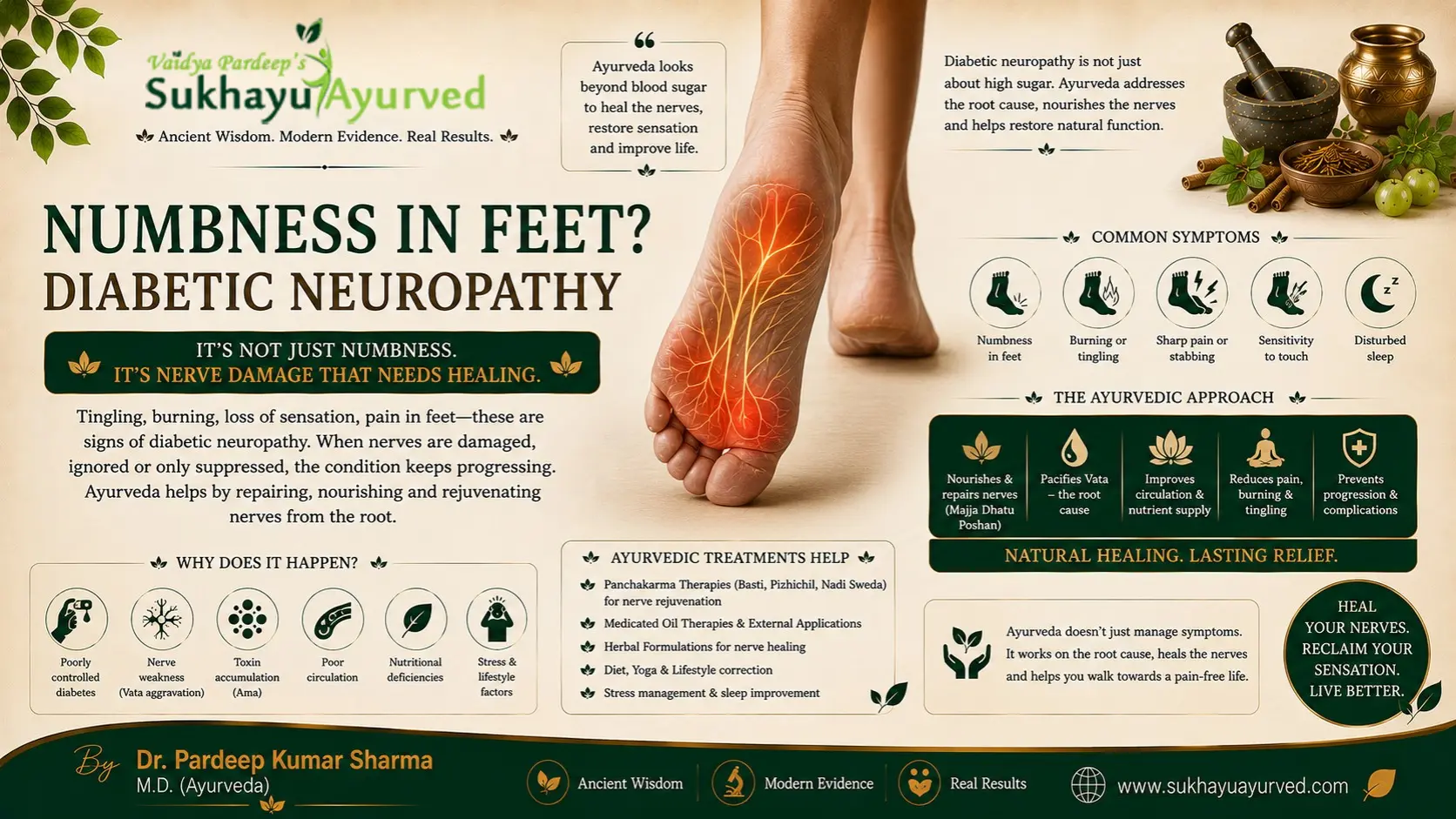
There is a sentence I hear almost every week in my clinic. A patient sits down, points to their feet, and says: "It's the diabetes, doctor. This numbness is just my sugar."
Sometimes they are right. Very often, they are not — and the assumption itself is part of why they are still suffering.
Numbness in the feet is one of the most self-diagnosed complaints I see. A person with diabetes feels tingling or loss of sensation in the toes, and because they already carry the label of a chronic disease, they attach the new symptom to the old diagnosis. It feels logical. But a short history of numbness in someone with diabetes does not automatically mean diabetic neuropathy. The feet are simply where many different problems announce themselves. The complaint is the same. The cause underneath it can be completely different — and the whole point of a proper assessment is to find out which problem you actually have before anyone starts treating it.
This article is about that separation. Not a symptom checklist you can score at home, but how the distinction is actually made in a clinic, and why it matters so much for what happens next.
What diabetic neuropathy actually looks like
When diabetic peripheral neuropathy is the real cause, it has a recognisable signature. It is distal, meaning it starts at the far ends — the toes and feet. It is symmetrical, affecting both sides in a similar way. And classically it produces a "stocking-glove" pattern: sensation is lost in the area a stocking would cover, gradually creeping upward over a long time, and often reaching the hands in the same glove-like distribution much later.
What it takes away, in the beginning, is a specific set of sensations — vibration, pain, and temperature. This is why some patients tell me they didn't notice a small stone in their shoe, or a blister that turned into an ulcer, because the protective feeling that would normally alert them is gone.
Left unaddressed, this can widen. As sensation fades, balance suffers, and unnoticed foot injuries become a real danger. In some patients the same disease process reaches the nerves that quietly run the body's automatic functions — producing dizziness on standing, an irregular heartbeat, or a stomach that empties too slowly. These are not separate diseases. They are the same diabetic process extending its reach.
That is the picture that genuinely fits the diabetes label. The problem begins when the picture doesn't fit — and the patient hasn't been told to look.
When it isn't the diabetes: the departures that change everything
In my in-person examination, I am not simply confirming the patient's own story. I am looking for the ways the presentation departs from that stocking-glove signature — because a departure points to a different cause, one that a diabetes-focused prescription will never touch.
A few of these departures matter more than any single symptom:
It affects one side, not both. Diabetic neuropathy is a systemic, metabolic process — it tends to be symmetrical. When numbness sits firmly in one foot or one leg while the other is spared, that asymmetry points away from a whole-body metabolic cause and toward something localised: a structural or compressive problem.
It follows a specific nerve or a specific band, not the stocking. When the loss of sensation tracks the territory of one particular nerve, or runs in a clear line down the back of the leg following a spinal nerve root, that is not the diabetic distribution. It suggests the nerve is being pinched or compressed somewhere along its path — often at the spine.
It behaves according to posture. This is one of the most useful clues in a compressive case. When symptoms appear or worsen in a particular position and ease in another, the nerve is being mechanically squeezed. Diabetes does not switch on and off with how you sit or stand.
There is muscle wasting or weakness leading the way. Diabetic neuropathy typically robs sensation long before it produces real muscle weakness. When I see muscle wasting, or weakness that is out of proportion to the numbness — or arriving early rather than late — I start thinking about an inflammatory or autoimmune process, such as a CIDP-type condition, rather than diabetes.
None of these is a box to tick at home. They are patterns that emerge from examining the patient properly — asking about onset, watching how the symptoms behave, mapping where sensation is actually lost.
The complaint that lives in the feet but starts in the spine
There is one distinction I never skip, because missing it is the most consequential error of all: a good number of "neuropathy" complaints are not peripheral neuropathy at all. The numbness is in the feet, but the problem is in the spine.
So when someone comes to me pointing at their feet, part of my examination is deliberately aimed higher up. Is there a low backache accompanying the numbness? A straight-leg-raise test and careful dermatome mapping can reveal that a nerve root is being compressed — a radiculopathy — rather than a nerve dying at the far end from metabolic disease.
And there is one finding I treat with particular seriousness. When a patient describes a tight, band-like sensation around the abdomen or trunk along with their limb symptoms, that is not a foot problem and it is not a simple peripheral neuropathy. That is a sign pointing to the spinal cord itself — the kind of finding associated with cervical myelopathy. That changes the entire conversation. It is a signal that imaging is needed without delay, and that this is not a case to sit on.
What imaging is really for
Here I want to say something that is easy to misunderstand. When I send a patient for an MRI, I am not sending them to get their diagnosis from the scan.
Imaging, in real clinical practice, is not the diagnosis. It is a tool for ruling things out — for confirming or excluding a compression, a structural cause, a cord-level problem — so that the actual diagnosis can be made with confidence. If you skip that step and simply treat the label the patient walked in with, you risk leaving the real cause untouched while the patient keeps suffering, sometimes for years.
That is the difference between examining a patient and processing a complaint.
Why so many patients arrive confused
Part of what brings people to me already frustrated is that the early handling of foot numbness is often the same for everyone, regardless of what is causing it. Too frequently, an early case — whatever its real origin — is met with the same prescription: gabapentin and vitamin B12, and little else. For a patient whose numbness is actually coming from a compressed nerve root, or an autoimmune process, this sameness is exactly why they stay confused and unrelieved. The medication addresses the sensation, not the reason for it.
I am not saying those medicines are wrong. For genuine cases they have their place, and no one should stop a prescribed medicine on the strength of an article. What I am saying is that the cause deserves to be worked out first — because the cause is what should decide the treatment, not the other way around.
How Ayurveda understands the numbness — and why it, too, resists shortcuts
In Ayurvedic terms, numbness sits at the meeting point of two doshas — Kapha and Vata together. The simplest way to picture it is a kind of overcovering: one dosha settling over and obstructing the normal functioning of the other.
But — and this is the same point I make about the modern side — this is not something a lookup table can decide for you. Whether a given case truly fits that pattern, and to what degree, is a judgement that requires pulse examination and clinical assessment of the individual patient. There is no common chart that sorts every numb foot into the right box. On both sides of medicine, the shortcut is the enemy of the correct answer.
There is a further consideration I weigh carefully in diabetic and autoimmune cases specifically: in these conditions the blood supply itself is often compromised. The vasculature that feeds the nerves is part of the problem, not a bystander to it. That vascular dimension shapes what is realistic to expect and how the case must be approached — it cannot be treated as an afterthought.
The honest limits — what this can and cannot do
I would rather a patient hear the boundaries from me before they book than discover them afterward.
Deeply chronic cases are difficult for any system of medicine, mine included. When nerve damage has been present and progressing for a very long time, no honest practitioner of any tradition can promise to undo it. I do not.
And there are cases I decline. An old, long-established foot drop, for instance, is not a case I take on — because the realistic yield does not justify holding out hope I don't have. Saying so is not a weakness in my practice. It is the same clinical honesty that makes the rest of what I say worth trusting.
Where Ayurvedic management does have a real role is in the cases that have been correctly separated out and are genuinely suited to it — where the cause is understood, the vascular picture is accounted for, and treatment is aimed at the actual process rather than the label. That is only possible when the separation described in this article is done first.
The one thing I want you to take from this
If you have diabetes and numb feet, do not assume the two are the same story until someone has actually examined you. Ask whether your pattern is symmetrical or one-sided. Ask whether your back or your posture plays any part. Ask whether anyone has ruled out a compression before settling on "it's the sugar."
The complaint in your feet is easy to name. The cause underneath it is what deserves the work — and it is what decides whether treatment will actually help you.
If you'd like your case assessed properly rather than by assumption, you can book a consultation with me here. Bring your history, your reports, and your questions.
You can also read more about our approach to peripheral neuropathy and the range of neurological conditions we treat.
This article is for educational purposes and reflects clinical experience in Ayurvedic practice. It is not a substitute for individualized medical evaluation. Ayurvedic management is intended to complement, not replace, conventional diagnosis and care — particularly in diabetic and autoimmune neuropathy, where ongoing conventional treatment and glycemic control must continue and prescribed medication should never be stopped without your treating doctor's guidance. Please consult a qualified physician for assessment specific to your case.