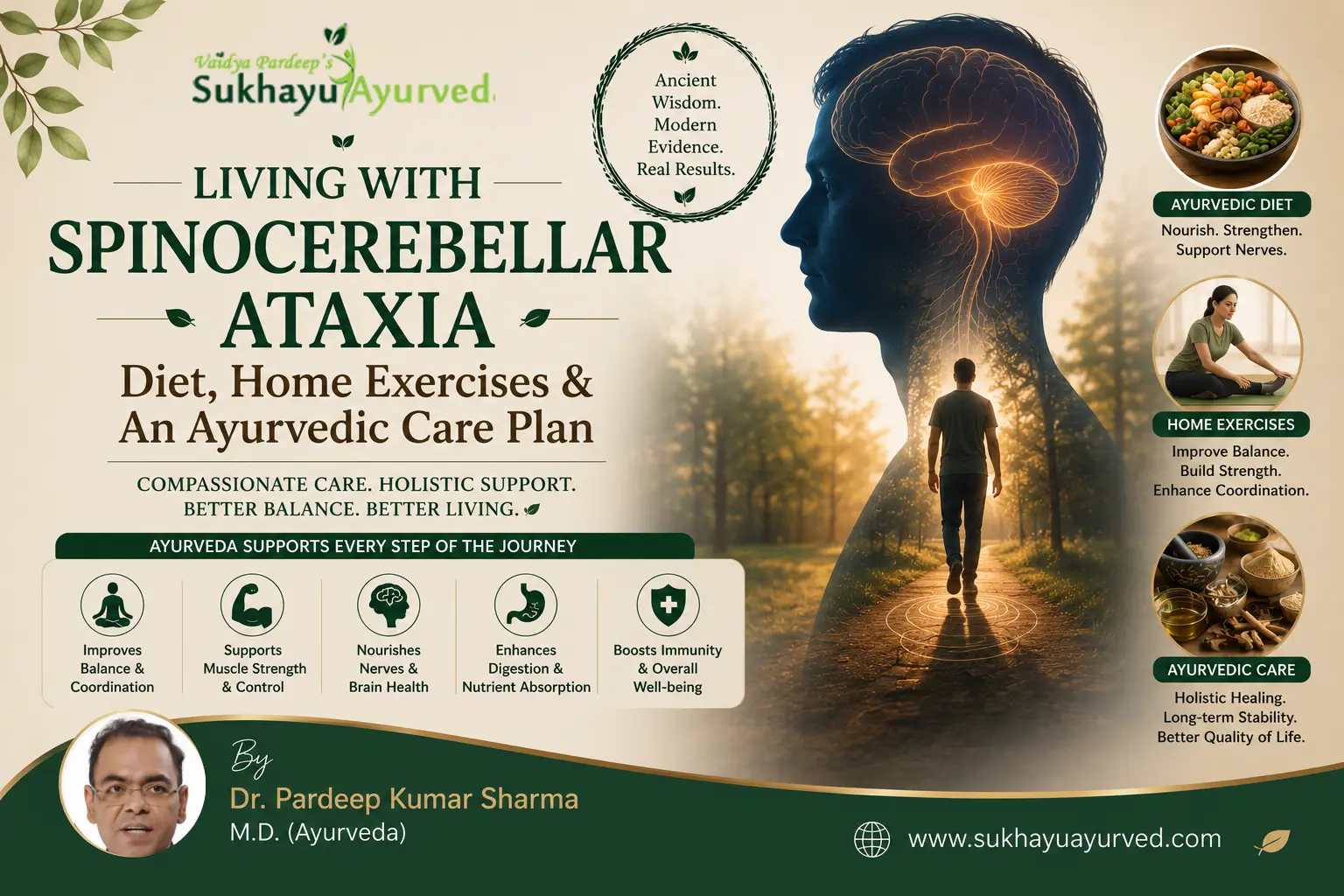
A spinocerebellar ataxia (SCA) diagnosis usually comes with a genetic test result and very little else — modern medicine can name the mutation, but it offers mostly symptomatic support for what follows. This piece covers what actually helps day to day: how Ayurveda understands SCA differently from "just another Vata disorder," what a real Panchakarma protocol for SCA looks like, the diet that matters, and a documented case from our own practice — not a composite, an actual patient's SARA score over two years.
What Is Spinocerebellar Ataxia?
SCA is a group of inherited, progressive disorders — SCA1, SCA2, SCA3/Machado-Joseph disease, and dozens of other subtypes — caused by specific gene mutations that degrade the cerebellum and its pathways over time. The result is a recognizable pattern: unsteady gait, poor coordination, slurred speech, tremor, and in later stages, difficulty swallowing. There is no cure in any system of medicine for the underlying genetic degeneration, and any article that promises otherwise should be read with suspicion.
How Ayurveda Understands SCA
Ayurveda classifies SCA as a Beejadushti janya condition — a disease seated in the Beeja (the genetic/seed material) itself, rather than one caused by an external or acquired imbalance. This distinction matters: it changes what treatment can realistically be expected to do.
The primary Dhatu involved is Majja (the tissue governing nerve and marrow function). In SCA, Vata becomes aggravated within Majja Dhatu specifically, and this sustained aggravation drives Majja Kshaya — a progressive depletion of Majja tissue. Classical texts describe this state precisely: a patient in Majja Kshaya is "Pratatam Vata Roginam" — someone who will remain, continuously, a patient of Vata disease. This is not a diagnosis you treat once and close; it describes an ongoing vulnerability that shapes the entire treatment approach.
The epigenetic lens
We frame SCA management around epigenetics — working on the body's overall homeostasis so that gene expression stays as contained as possible, rather than treating this as a purely symptomatic exercise. In practice, this means:
- Early-stage patients — balance can typically be maintained well, and disease expression kept contained.
- More progressed cases — the realistic goal shifts to meaningfully improving quality of life, not reversing existing degeneration.
This is why timing matters more in SCA than in most conditions we treat: the earlier the intervention, the more the homeostatic approach has to work with.
Our Panchakarma Approach
Because Majja Kshaya in SCA is driven specifically by Vata, the Panchakarma protocol is built around Vata management — and deliberately excludes two therapies that are standard elsewhere.
- Basti is the primary therapy. As the classical treatment of choice for Vata disorders, medicated Basti (both Kashaya and Taila) forms the backbone of the protocol.
- Vamana and Virechana are contraindicated. Both increase Vata physiologically, which runs directly counter to what a Majja Kshaya patient needs — this is a deliberate exclusion, not an oversight.
- Nasya is included specifically for its access route: Nasa hi Shirso Dwaram — the nose is the gateway to the head — making it the direct path for delivering therapeutic effect toward the brain.
- Shalishashtika Pinda Sweda and Choorna Pinda Sweda are used, as needed per patient, to support neuromuscular coordination.
These therapies run in parallel rather than in strict sequence, adjusted to where the individual patient is in their disease course.
[INTERNAL LINK: /neurology "See our full neurological treatment approach"]
Case Study: Mr. Prakhar Bharti's SCA Journey
Real outcomes matter more than protocol descriptions, so here is a documented case from our own practice.
Mr. Prakhar Bharti, 48, was diagnosed with SCA at 45, with a strong family history of the condition. By the time he first came to Sukhayu Ayurved, he had loss of balance and coordination, slurred speech, an unsteady gait with frequent falls, difficulty swallowing, intermittent tremors, disturbed sleep, and mood swings. His SARA score (Scale for Assessment and Rating of Ataxia) was 30 — severe neurological dysfunction.
First admission (January 2023, 21 days) was structured in phases: Week 1 focused on Aama Pachana, Kashaya and Taila Basti for Apana Vata, Choorna Pinda Sweda, and Udvartana. Weeks 2–3 shifted to Shiro Basti, Pizhichil, and Shashtika Shali Pinda Sweda, alongside continued Basti therapy. At discharge, his SARA score had moved from 30 to 28, with early improvement in mood, sleep, and motor coordination.
Second admission (June 2023, 14 days) repeated the core Vata-pacifying protocol. His SARA score, which had drifted to 22 between visits, improved to 18 — a 40% improvement since his first visit.
At his February 2025 follow-up, Mr. Bharti was living independently, with no more choking episodes, improved gait and balance, clearer speech, stable mood, and no tremors in recent months. His SARA score stood at 10 — down from 30 at presentation.
This case doesn't represent a cure — the underlying genetic condition remains — but it shows what sustained, correctly-targeted management can do for functional independence and quality of life.
Diet for Spinocerebellar Ataxia
Diet is not incidental in Majja Kshaya management — it directly supports or undermines the Vata-pacifying work done in the clinic.
Foods to avoid (Vata-aggravating): moong daal, spinach, mustard leaves, sprouts, cauliflower, cabbage, and peas — both green and frozen.
What to favor: meals with balanced unctuousness (oiliness), which helps contain Vata's inherently dry, light, mobile qualities. Sesame oil in particular is considered highly beneficial in this condition.
One specific caution: curd (yogurt) should be avoided. Its Abhishyandi quality — a tendency to cause congestion or occlusion — works against keeping the srotas (channels) clear, which matters directly for a condition rooted in channel and tissue health.
[INTERNAL LINK: /gastroenterology "More on how diet interacts with dosha balance"]
Home Care & Safe Movement
Alongside clinic-based Panchakarma, day-to-day home management supports the same goals:
- Gentle, balance-safe movement — done under guidance, not self-directed, given the real fall risk in SCA.
- Continued coordination with physiotherapy and speech therapy, which remain essential, evidence-backed tools alongside Ayurvedic care, not replaced by it.
- A steady daily routine (Dinacharya) and stress reduction, since irregularity and stress are understood to aggravate Vata further.
- Close attention to swallowing safety at mealtimes, given dysphagia is a common feature of the condition.
☞ A physiotherapy or neurology resource on fall-prevention and balance training for ataxia patients
What to Realistically Expect
As Mr. Bharti's case shows, the timeline for meaningful change is measured in months and years, not weeks — his most significant gains built up across two admissions and nearly two years of continued care. Early-stage patients, where homeostasis can still be maintained well, tend to see the most from this approach. Later-stage patients can still see real quality-of-life improvement, but expectations should be calibrated to where the disease already stands.
Conclusion
Spinocerebellar Ataxia is a genetic, progressive condition, and any honest treatment plan starts by saying so. What Ayurveda offers at Sukhayu is a specific, Vata-focused Panchakarma protocol built around the Majja Kshaya mechanism, paired with diet and home care — and a real, documented case showing what two years of that approach can look like. If you're evaluating options for yourself or a family member, we're glad to discuss what's realistic for your specific stage of the condition.