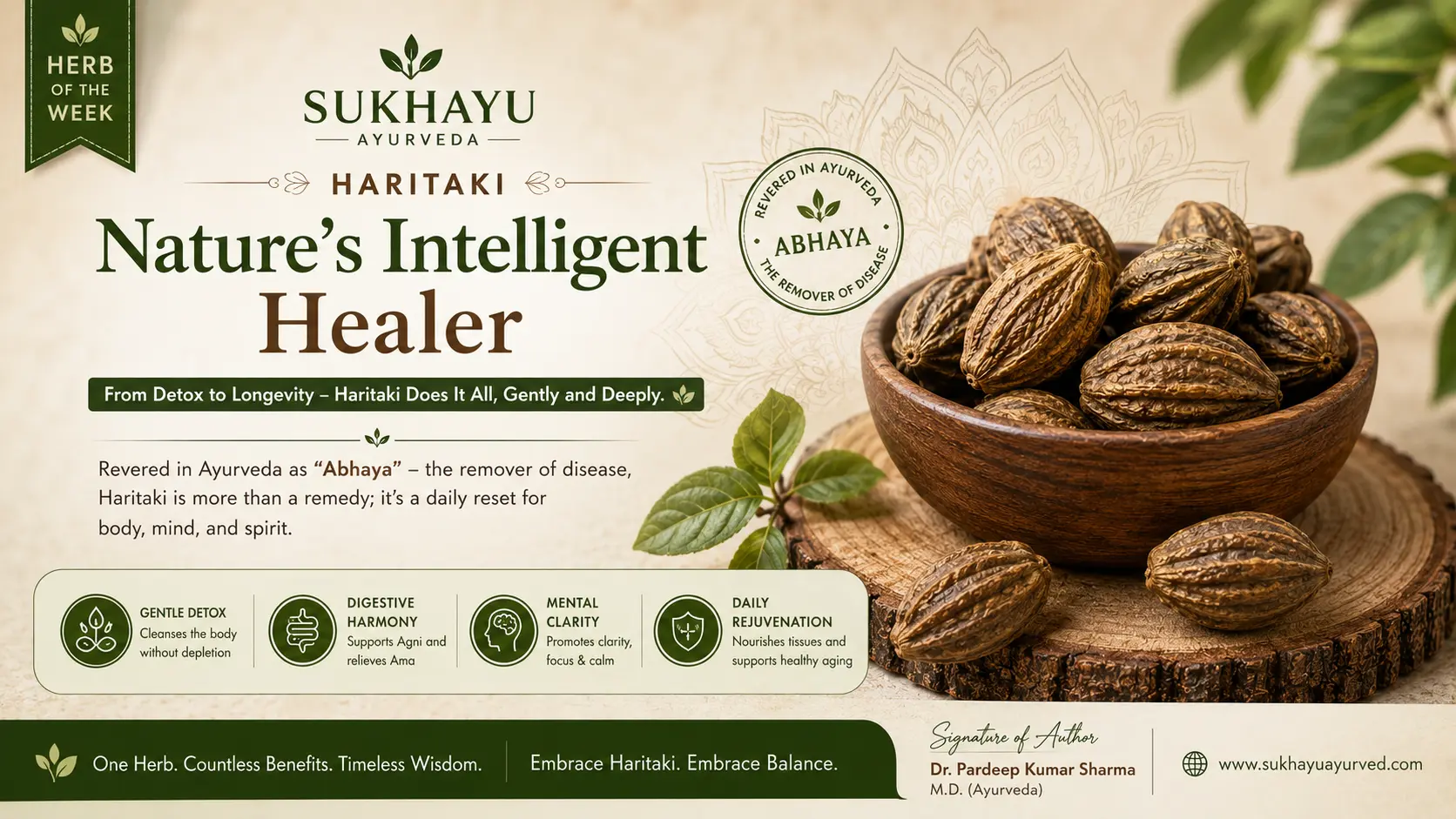
When the classical texts reach for their highest praise, they tend to reserve it for the rare and the dramatic — the gold-based rasa preparations, the fierce Panchakarma procedures. So it is worth pausing over the fact that one of the most exalted places in the entire materia medica is given not to something rare, but to a small, wrinkled, astringent fruit that grows on ordinary trees across the subcontinent: Haritaki.
Charaka places it at the very top. The tradition calls it, among other things, the physician's own — and I will come to what that title actually means, because it is almost always misread. For now, hold the puzzle: why would the classical physicians, who had access to the whole pharmacopeia, elevate this fruit above nearly everything else?
The lazy answer is reverence — that it is praised because it is old and beloved. But that is not why a physician praises a drug. A physician praises a drug because of what it does. So let me tell you what Charaka actually saw.
The real reason: a near-complete taste in a single fruit
In Ayurveda, a substance's therapeutic character begins with its rasa — its taste — because rasa is not merely flavour but the first signature of how a substance will behave in the body. There are six rasas in all: Madhura (sweet), Amla (sour), Lavana (salty), Katu (pungent), Tikta (bitter), and Kashaya (astringent). Most herbs carry one or two. A herb with three is already versatile.
Haritaki carries five.
It holds every rasa except Lavana (salt). Its dominant note is Kashaya — astringent — but trailing behind it, in the anurasa, the after-taste, sits Madhura, sweet. A single fruit that spans from astringent at one end to sweet at the other is a single fruit that can speak to the entire doshic field. This is the clinical substance behind Charaka's superlative. It is not devotion. It is dravyaguna — the sheer pharmacological breadth of one substance — that lets Haritaki address all three doshas from a single source. A herb that broad was never going to be a narrow, single-purpose remedy.
And the classical description is more precise, and more astonishing, than even that. The Bhavaprakasha maps the five tastes onto the anatomy of the fruit itself. The pulp (majja) is svadu — sweet. The fibrous part (snayu) is amla — sour. The stalk (vrinta) is tikta — bitter. The skin (tvak) is katu — pungent. And the seed-region (asthi) is tuvara — astringent. The five tastes are not an abstract claim about the fruit; they are physically distributed across its parts. One fruit, five rasas, laid out anatomically — this is what the ancients meant when they said Haritaki carries almost the whole spectrum in its own body. Almost no popular article ever mentions this, and it is precisely the detail that turns the praise from poetry into pharmacology.
What "greatest of herbs" does not mean
Here I have to be blunt, because the internet has turned this breadth into something dangerous.
A fruit described as acting on digestion, the eyes (chakshushya), the intellect (medhya), the skin, the breath (in shvasa and kasa), on prameha (metabolic and urinary disorders), on arsha (piles), kushtha (skin disease), shotha (swelling), krimi (parasites) — plus Rasayana, rejuvenation — reads, to a modern skeptical eye, like a snake-oil list. Too many claims. Too good to be true.
It would be, if these were ten separate cures. They are not. They are one action expressing itself in ten places.
This is the point most writing on Haritaki misses entirely, and it is the point I want you to take from this article above all others. Ayurveda does not work the way a modern single-molecule drug works — one compound, one target, one effect. It works through agonism and antagonism: the same substance, carried by a different anupana (vehicle), placed within a different protocol, becomes a different clinical instrument in a different condition. This is why it is simply false — a blunt lie, and I choose those words deliberately — for any physician to say "I prescribed Haritaki and the patient recovered." That sentence attributes the outcome of a whole protocol to a lone fruit, and it is not how this medicine works or how honest medicine is described. Haritaki's clinical meaning is inseparable from what it is combined with, what it is carried in, and the entire treatment built around it.
So when you read that Haritaki "does" all these things, do not read a menu of miracles. Read the range of a single, versatile substance that a trained hand can re-point in many directions.
The action beneath all the actions: anulomana and gati
If breadth is the what, then here is the how — the mechanism that unifies the whole list.
Haritaki is celebrated as anulomana. This word is routinely, and wrongly, translated as "laxative." Anulomana does not mean "moving things down." It means ensuring that a process proceeds in its correct direction.
Consider how the two medical languages describe the body. Modern biology describes a physiological function as a sequence of steps — a pathway, a cascade. Ayurveda reads the same reality as gati — directional flow, the movement of a process along its proper course. Disease, in this framing, is very often a gati gone errant: a process moving sluggishly, or in the wrong direction, or stalling where it should flow. Anulomana is the restoration of correct direction to a process that has lost it.
The bowel is simply the one place where this directional correction produces a visible, undeniable, next-morning result — which is exactly why the culture collapsed anulomana into "laxative" and stopped there. But the principle is far larger than the colon. The apana movement that governs the downward, outward functions of the lower body is one theatre of it — and where those functions falter, the relevance touches conditions well beyond simple constipation. Yet to stop at Vata and the bowel would be to repeat the same reduction in a smaller form.
Because the deeper truth is this: Haritaki's work is metabolic correction. It restores the right direction to physiological processes — and a substance that corrects the process itself cannot belong to a single dosha. It serves all three, precisely because faulty direction is not a Vata problem or a Pitta problem but a problem of the process. Vata is only where the correction is most visible; it is not where it ends. This is what ties the ten-item list back into one: eyes, skin, digestion, breath, metabolism — different doors, one action, restoring things to their proper course.
How it is actually prescribed — the vehicle makes the medicine
This is the most important practical point, and it follows directly from everything above. The same Haritaki becomes a different medicine depending on how it is carried.
The classical system is explicit about this. Taken with Saindhava (rock salt), with sugar candy, or with ghrita (ghee), Haritaki turns its character toward one dosha or another; roasted and prepared in particular ways, it serves differently again; taken by season — the tradition of Ritu Haritaki — the adjuvant shifts with the time of year. I have set out the basic anupana-by-dosha framework on our dedicated Haritaki reference page, and you can read the classical pairings there.
But I will not lay out a condition-by-condition prescription chart here, and the reason is now obvious: it is the vehicle and the combination that set the clinical intent, which means a public "take X with Y for condition Z" table is an invitation to self-medicate on half-understood information. That Haritaki's action bends so completely to its anupana is precisely why it is a physician's herb — and not a self-serve supplement. The right next step is never a screenshot of a dosage table; it is a consultation in which the vehicle, the combination, the season and the state of the patient are all judged together.
Haritaki is also, of course, the lead fruit of Triphala, and if you want to understand why three fruits are combined at all — and why the formulation logic is a different subject from this one — that is a story I have told separately, in the Triphala article . Its siblings, Bibhitaki (Bahera) and Amalaki, each carry their own pages.
What modern study sees — as a parallel, not a proof
Modern phytochemical work on Terminalia chebula has catalogued something like 149 compounds in the fruit — tannins, phenolic acids, chebulic and chebulinic acids, gallic and ellagic acids, flavonoids, triterpenes — and reports a broad range of studied activity: antioxidant, anti-inflammatory, hepatoprotective, anti-diabetic, antimicrobial, neuroprotective (Molecules, 2024, PMC11643145). The same review is honest that important gaps remain in understanding its mechanisms, pharmacokinetics and safety.
I offer this not as validation of anything the classical texts said. Let the science remain science: it is a parallel observation, arrived at by a completely different method, that a single fruit demonstrates unusually broad, multi-target biological activity. That modern breadth rhymes with the classical breadth of five rasas and a dozen indications — but a list of in-vitro and animal activities of isolated compounds is not the same thing as the anupana-dependent, protocol-embedded clinical use I have described. The two are looking at the same fruit through different windows. Neither one proves the other. Both are worth seeing.
The whole point, in one breath
Strip away the superlatives and Haritaki comes down to something quiet and precise: a fruit whose real greatness is not that it cures a hundred things, but that it is the physician's most trusted instrument for doing the one thing all treatment finally aims at — returning the body's processes to their right direction.
That is why the tradition called it Amrita, mother to the physician. Not because it is magical, but because it is dependable in trained hands. And it points to a truth larger than any single herb: health is not the addition of something new to the body, but the restoration of things to their proper course — and the physician's work is less about force than about direction. Cure is divine. Treatment is possible. And treatment, at its best, is simply the art of helping a process find its way back to where it was always meant to go.
Dr. Pardeep Sharma, M.D. (Ayurveda) is the founder of Sukhayu Ayurved, Jaipur. With over 20 years of clinical experience in Ayurvedic management of orthopedic, neurological and autoimmune conditions.
To understand how Haritaki — or the wider Ayurvedic approach to correcting metabolic and digestive processes — applies to your specific condition, book a consultation or reach our clinic directly.
Medical disclaimer: This article is for educational purposes only and does not constitute medical advice, diagnosis, or a prescription. Haritaki and all Ayurvedic formulations are profoundly dependent on the correct vehicle (anupana), combination, dose and timing for the individual patient, and must be taken only under the guidance of a qualified physician. Do not self-medicate, and do not discontinue any prescribed treatment without consulting your doctor.