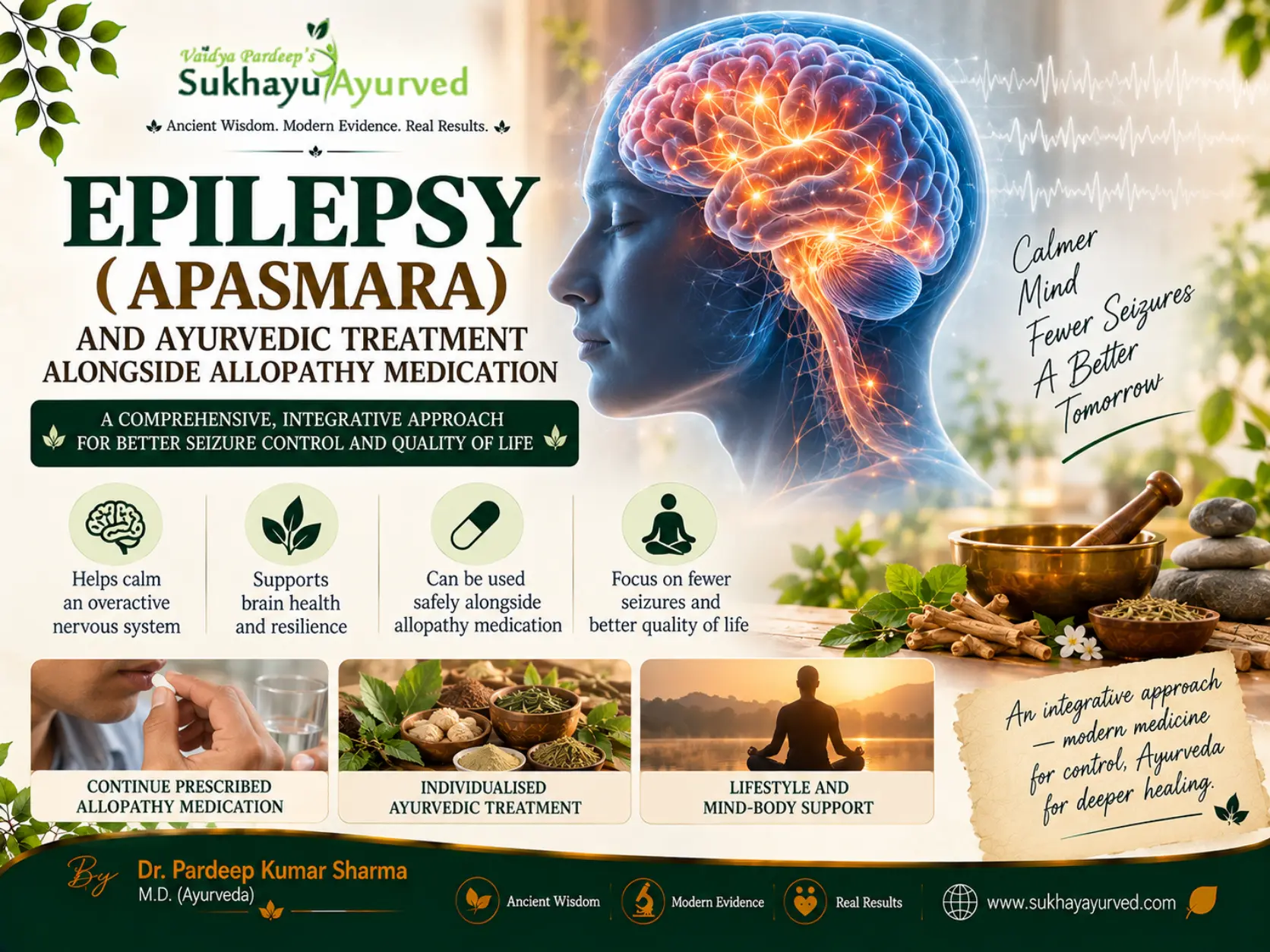
A family sitting across from me with a child's seizure history usually asks one of two questions. Can Ayurveda handle this? Or: we are already on medicines, so is there any place for Ayurveda at all?
Both questions have honest answers, and they are not the same answer. I will take them in order, because the most useful thing I can tell you about epilepsy is that the right plan depends on what the seizures actually look like.
The first thing I assess: frequency, duration and severity
Before any discussion of Ayurveda, I want to know three things about the attacks: how often they come, how long each one lasts, and how severe they are.
Those three answers decide the plan more than any label does.
When Ayurveda can lead, and when it should not
If the seizures are very brief, almost like ticks, with no fall and no severe movement of the body, Ayurveda can lead from the front. That is my clinical position, and I hold it for a physician who is well trained and experienced in managing these cases.
In other presentations, a neurologist's involvement is required.
Even in the mild group, the plan is not fixed. If the frequency rises, or the patient begins to fall, a neurologist's opinion is the obvious next step. If medicines are needed, they can be started from that side. Ayurveda does not stand in the way of that decision.
What I never do: stop another doctor's medicines
If a patient is already on anti-epileptic medicines prescribed by another doctor, I do not stop them. Withdrawal can lead to complications. The medicines continue unchanged, and they are kept uninterrupted through every Ayurvedic procedure as well.
Ayurvedic management in these patients works alongside the conventional treatment. It does not replace it.
How Ayurveda understands Apasmara
Epilepsy is described in Ayurveda as Apasmara. What I value in the Charaka Samhita's account is that it does not place the disease in the brain or in any single anatomical structure. It describes a whole picture.
In a person whose mind is already afflicted by rajas and tamas, and whose doshas are disturbed by improper diet, improper conduct or depletion, the vitiated doshas settle in the hridaya and in the seats of the indriyas. Then a sudden surge of emotion, such as desire, anger, fear, greed, grief or anxiety, fills these seats and the person has an attack.
Charaka then defines the state itself:
अपस्मारं पुनः स्मृतिबुद्धिसत्त्वसम्प्लवाद्बीभत्सचेष्टमावस्थिकं तमः प्रवेशमाचक्षते||५||
In plain terms: a disturbance of memory (smriti), intellect (buddhi) and the stabilising quality of the mind (sattva), with distorted movements, a temporary entry into tamas.
Charaka also describes four types by dosha: vataja, pittaja, kaphaja and the combined sannipataja type. Their signs differ.
- Vataja: trembling, clenching of the teeth, frothing at the mouth, and harsh, reddish or dark visions.
- Pittaja: yellow froth, thirst, a sense of heat, and visions of fire or yellow, blood-coloured forms.
- Kaphaja: white froth, a cold and heavy body, white visions, and a slow recovery from the attack.
What the treatment looks like
The Chikitsa Sthana gives the full protocol. Charaka's logic is that the doshas have covered the channels of the heart and the mind, so the first task is to clear that obstruction with strong measures such as Vamana. Then the procedure is matched to the dosha: Basti for the vataja type, Virechana for the pittaja type, and Vamana for the kaphaja type.
In my practice this looks like the following.
- Most cases begin with medicines and Nasya (the shamana form). In young patients, Nasya can be done at home.
- In adults, Vamana is used in kaphaja cases, Virechana in pittaja cases, and Basti in vataja cases.
- Classical ghrita and taila preparations form the medicines I use.
- No Vamana or Virechana before the age of 16.
Counselling is not optional
The medicines and procedures are one part of the plan. Counselling is the other, and in Apasmara it is a must, especially in young patients.
One point I make to families: the child must not be pampered. Pampering increases agitation, irritation and irrational behaviour in the patient.
The everyday advice is simple and I give it to every patient:
- Regular sleep and regular meals, and no fasting.
- Reducing stress where it can be reduced.
- Avoiding heights and water, and no driving.
A case from my clinic
A boy aged 12 came to Sukhayu in July 2024. He was having seizures every fifth to seventh day, with jerks through the whole body and mild foaming from the mouth. Each episode lasted under two minutes. The frequency had risen suddenly from March 2024, with episodes becoming more regular and closer together.
He was managed with Ayurvedic medicines under our care. In the first week there was no improvement. After that the frequency reduced during the first month, and he has had no episodes since. His Ayurvedic medicines were stopped in February 2026.
This is one patient. I share it as an honest account of what happened, not as a promise about what will happen for another child. Every patient is assessed on the three points above.
What Ayurveda cannot lead
Some presentations are not suited to an Ayurveda-led plan. When fits come very regularly, last for many minutes, and carry the features of all the doshas, together or with different doshas showing in different episodes, the classical texts call this asadhya: very difficult to manage. This is the group where I would not tell a family that Ayurveda can lead.
The message for families
If your child or family member has epilepsy:
- Do not stop any medicine on your own, or because someone suggests it. Withdrawal can cause complications.
- Note how often the seizures come, how long they last and how severe they are. That record is the most useful thing you can bring to any doctor.
- If the seizures become more frequent, or a fall occurs, see a neurologist.
- Choose a physician who is well trained and experienced in managing Apasmara.
This article is for educational purposes and reflects clinical experience in Ayurvedic practice. It is not a substitute for individualized medical evaluation. Ayurvedic management is intended to complement, not replace, conventional diagnosis and care, particularly for epilepsy, where stopping anti-epileptic medicines or delaying conventional treatment can have serious consequences. Please consult a qualified physician for assessment specific to your case.