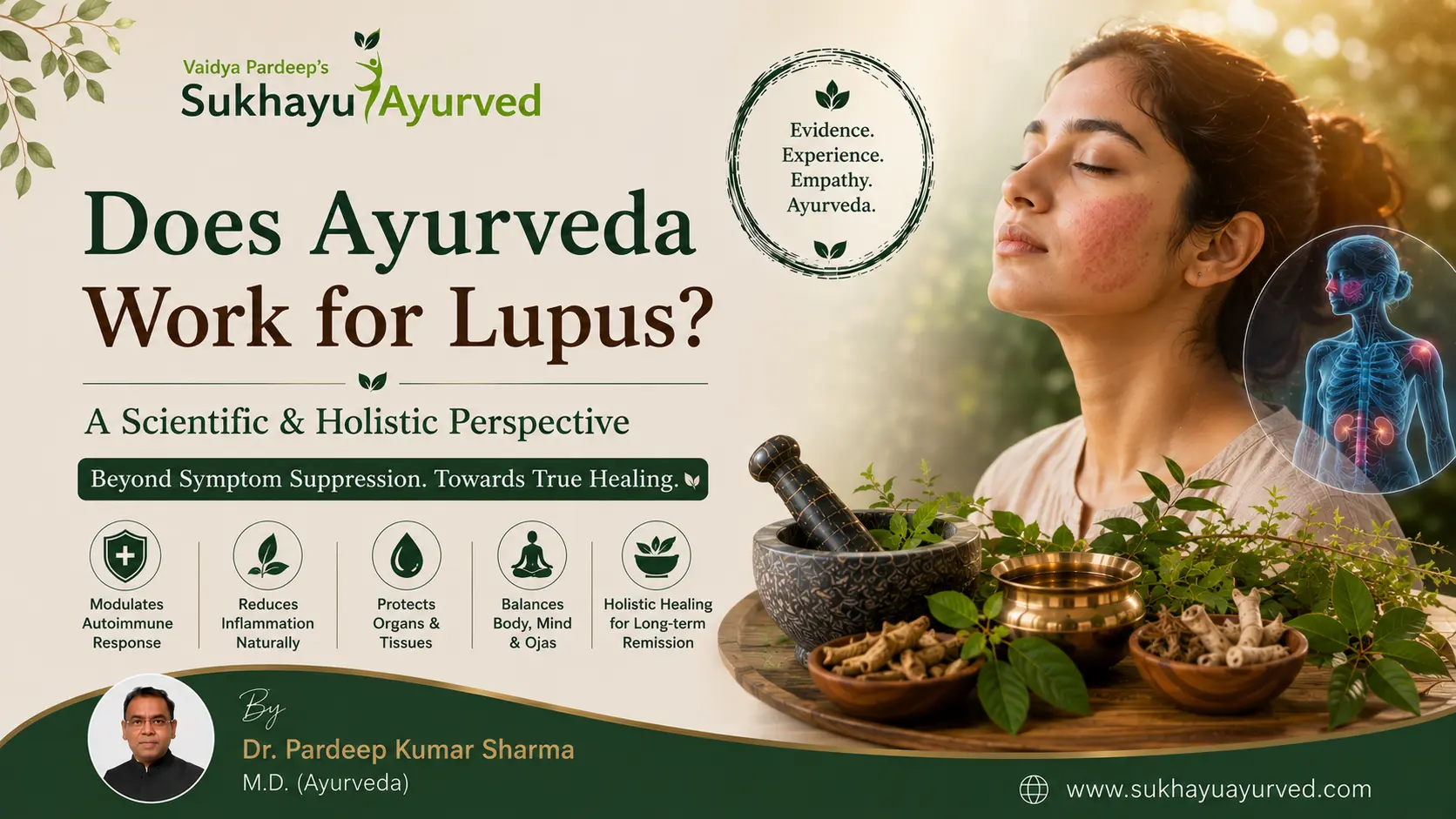
Let me answer the question you came here to ask, plainly, before I explain anything.
Yes. Ayurveda works for lupus — but not the Ayurveda you have been reading about online.
Not turmeric. Not Shilajit. Not Ashwagandha. Not a "cooling Pitta diet." Not a bottle of Giloy that promises to fix your immune system while you scroll past it at 2 a.m.
Those are not treatment. Those are marketing.
What follows is the other Ayurveda — the one written in Charaka and Sushruta, the one practised inside a hospital, the one that reads your ANA and your anti-dsDNA and your serum creatinine as carefully as it reads your pulse. This is the Ayurveda that has, in my clinic, brought a patient's creatinine from 2.2 back to 0.9, and quieted a disease that eighteen months of continuous medication had failed to slow.
I will show you that case in full. But first, you need to understand what lupus actually is, in a language most Ayurveda articles never bother to speak.
What lupus really is — the body forgetting itself
In modern medicine, Systemic Lupus Erythematosus (SLE) is an autoimmune disease: the immune system, which exists to defend you, turns and attacks your own tissues — joints, skin, kidney, blood.
Ayurveda saw this same chaos thousands of years ago and gave it a name that is almost frighteningly precise: Gambhīra Vātarakta — deep-seated Vātarakta — and specifically Āmaja Vātarakta, the variety born of Āma.
To understand why that name matters, you have to understand two forces inside your body.
Agni is the gatekeeper. Agni is not merely "digestive fire." Agni is discernment — its true skill is Vivechana, the ability to analyse and decide: this is good, keep it; this is harmful, discard it. Every gate needs a gatekeeper who can tell friend from foe. In your body, that gatekeeper is Agni.
Ojas is your strength — your Bala. Ojas is the refined essence of all your tissues, and it behaves as Bala: the true immune response of the body. Part of it is inherited, part is acquired through good living, and part rises and falls with age, season, and the terrain you live in. Ojas is what makes your body yours.
Now here is where lupus begins.
When Agni weakens, the gate is no longer guarded by a discerning mind. And a weak gate lets in Āma — the sticky, improperly processed residue of failed digestion and failed metabolism. This is the first mistake.
The second mistake is far crueller. Āma resembles Ojas in its qualities — its Gunas. The counterfeit looks like the currency. So when Āma slips past the weakened gate and enters circulation, the body cannot cleanly separate it from Ojas. The two mix. And the immune system, now reading a blend of the real and the false, becomes hyperactive — firing at everything, unable to tell what is self and what is not.
This is the moment I call the loss of Ātma-Samyoga — the loss of self-recognition. The body forgets which parts are itself. It has been given a forgery so similar to its own essence that it can no longer trust even its own tissue.
That, in Ayurvedic terms, is autoimmunity. Not a mystery. A gate that failed, and a forgery that got in.
Once you understand lupus this way, everything about its treatment changes — and everything about the internet's treatment of it collapses.
Why most "Ayurveda for lupus" advice is quackery — and why patients fall for it
I want to be blunt here, because gentleness has a cost in this field and my patients pay it.
The turmeric–Shilajit–Ashwagandha version of Ayurveda cannot touch lupus. Not because those herbs are worthless, but because the pathology is deep — Gambhīra, Āmaja — and it lives in the Rakta and the Dhātus, entangled with the body's very sense of self. You do not reach that with a supplement. You reach it with a system.
So why does the misinformation spread so easily? Why do intelligent, educated patients hand their money to quacks?
The answer is not stupidity. It is despair.
Here is what happens. A patient is diagnosed with SLE. And somewhere in that first month, a doctor says the sentence that changes everything: "You will need to be on these medicines for life."
That sentence, however well-intended, slams a door. Lifelong dependence is a terrifying thing to accept, especially at twenty-nine, especially before you have even understood what happened to you.
And here is the truth about human beings: when we are alone and comfortable, no one goes looking for an exit. But in chaos, we all start searching for a way out — needed or not, real or not. It is instinct.
The quacks know this instinct. They are not selling medicine. They are selling the exit. They arrive precisely at the moment of despair, with confident marketing and a promise no honest doctor would make, and they collect quick money from frightened people who simply could not bear the word "lifelong."
I built my practice as the counterweight to exactly this. So let me now show you what real treatment looks like — and what it actually achieved.
A case from my practice
Clinical details are presented exactly as recorded. Identifying information has been changed. This is one patient's documented course, not a promise of any specific outcome.
The patient: A 29-year-old woman, right-handed, born of a consanguineous marriage. She came to Sukhayu Ayurved after eighteen-plus months of continuous conventional treatment — and her symptoms were not improving. They were slowly getting worse, in spite of regular medication.
What she was living with:
- Pain in all joints
- Morning stiffness lasting more than 30 minutes
- Fatigue — exhausted even without exertion
- A butterfly rash across her face
- Photosensitivity in the rash area
- Loss of appetite
- Disturbed sleep
What her reports showed:
| Marker | On arrival |
|---|---|
| ANA | Positive |
| Anti-dsDNA | Raised |
| Haemoglobin | 9.8 mg/dl |
| ESR | 38 |
| hs-CRP | 22.89 |
| Platelets | 1,12,000 |
| Serum Creatinine | 2.2 mg/dl |
Diagnosis: SLE, with the creatinine and the anaemia telling me the disease had already reached beyond the joints and skin.
The treatment — and the logic behind every step
I do not treat lupus with a package. I treat it with a sequence, and every step in that sequence answers a specific problem in the pathology. Here is the reasoning, not just the menu.
Step 1 — Āma Pāchana and Dīpana (Week 1, at home). We begin where the disease began: at the gate. Before anything else, we rekindle Agni and digest the Āma, using medicines and a corrected diet. This was done at home, before admission, through online consultation and guidance. You cannot purify a body that is still manufacturing toxins. First, close the tap.
Step 2 — Virechana (admitted, IPD). Once the Āma is loosened, we remove the deep-seated Doshas through Virechana (therapeutic purgation). Note carefully: Vamana is not a choice in a condition like this. The pathology is deep and Rakta-bound; Virechana is the correct route to evacuate it.
Step 3 — Tikta Kṣīra Basti — the heart of the treatment. This is the step that separates real treatment from guesswork. In lupus we need two things at once: Rakta Prasādana (purification of the blood) and Vāta Śamana (pacification of Vāta). Bitter — Tikta — herbs are superb blood purifiers. But there is a trap: Tikta Rasa itself aggravates Vāta. So if you simply give bitters, you clean the blood and worsen the Vāta in the same breath.
The classical solution is elegant: deliver the bitters as a Kṣīra Basti — a medicated milk enema. The Basti route calms Vāta even as the Tikta herbs purify the Rakta. You get both actions, and you pay neither penalty. This is why Tikta Kṣīra Basti sits at the centre of the protocol.
Step 4 — Shirodhara and Parisheka — chosen for her, not for a template. Shirodhara was included specifically because of her anxiety and stress — the mind that a chronic diagnosis leaves frayed. Parisheka (therapeutic pouring) with Tikta dravyas continued the same two-fold aim at the level of the skin and tissue: Rakta Prasādana and Vāta pacification. These were her therapies, matched to her presentation — not a fixed list handed to everyone who walks in.
The timeline
- Week 1 — Āma Pāchana and Dīpana at home; diet and lifestyle corrected.
- Weeks 2–4 — Admitted for Panchakarma (IPD). After this round she felt lighter; pain reduced mildly.
- Month 4 — Repeat Panchakarma, Basti-focused. Roughly 80% reduction in symptoms. It was at this point that her own rheumatologist — reviewing her improvement — began reducing her hydroxychloroquine dose. We did not touch her medication ourselves. We never do.
- Month 8 — Third maintenance sitting. Fully stable, no relapse.
- Month 11 onward — Minimal maintenance medicines. She remains under care.
What changed
| Marker | Before | After |
|---|---|---|
| Haemoglobin | 9.8 mg/dl | 13.2 mg/dl |
| ESR | 38 | 16 |
| hs-CRP | 22.89 | 2.89 |
| Platelets | 1,12,000 | 2,22,000 |
| Serum Creatinine | 2.2 mg/dl | 0.9 mg/dl |
And the life underneath the numbers:
- Morning stiffness fell from over 30 minutes to under 5.
- The butterfly rash disappeared.
- Photosensitivity resolved.
- Appetite, sleep, and energy returned.
I want you to sit with one line in that table. Serum creatinine, 2.2 to 0.9. That is a kidney stepping back from harm. That is what happens when you treat the cause — the Agni, the Āma, the Ojas — and not just the symptom.
So — does Ayurveda "cure" lupus? My honest position
Here is the line I stand behind, and the reason I choose my words as carefully as I choose my Bastis:
Cure, in lupus, means the reversal of the immune system's behaviour — quieting the very memory stored in those ANA and anti-dsDNA proteins, the memory that is capable of re-triggering the whole immune assault the moment it is provoked again.
SLE is well and truly treatable. In responsive, properly screened patients, there comes a point where the body no longer needs to lean on medication.
But I will not sell you the exit the quacks sell. Because there is a permanent condition attached, and it is non-negotiable: even after every medicine has stopped, a strict check on diet and lifestyle is mandatory — in every case of SLE, for life.
That is the honest bargain. Not freedom from responsibility. Freedom from dependence, in exchange for lifelong discipline. The disease is treatable; the discipline is forever. Anyone who tells you otherwise is selling you the exit, not the cure.
Cure is divine. Treatment is possible.
Who this works for — and who it does not
Twenty years of treating autoimmune disease has taught me that honesty about limits builds more trust than any success story. So let me tell you exactly where this approach helps and where it does not.
And I will start with something most clinics never say: medical eligibility alone never decides the outcome in a disease like this. Willingness does.
This works best for the patient who is:
- Genuinely motivated, and ready to change how they live
- Seeking a natural, root-cause approach rather than a shortcut
- Prepared to do the long, disciplined work with their diet and their days
A willing patient with modest disease will outperform a reluctant patient with mild disease, every time. That is why willingness comes before medical inclusion, not after it.
And here is where I will not carry you alone. These are my exclusions:
- Serum creatinine above 5 — the kidney is too compromised for this to be the lead treatment.
- Established joint deformity — once the structure has changed, we are past what this can reverse.
- Critically unstable patients who need regular emergency care — these belong in emergency and specialist hands first.
In these situations, Ayurveda is support, not solution. And in all situations, Ayurveda works best alongside your specialist — not in place of them. My patient's HCQ was reduced by her rheumatologist, watching her improve. That is the model. That is how this is meant to be done.
If you are living with lupus, here is your right first step
If you are newly diagnosed and frightened by the word "lifelong" — breathe. You do not have to make a decision from inside that fear.
If you are eighteen months in, doing everything right, and still slipping — like the woman whose story you just read — know that a plateau on medication is not the end of the road. It may simply mean the cause was never addressed.
The right first step is not to stop anything, and not to buy anything. It is to get properly assessed — to have someone read your reports and your body together, honestly, and tell you whether you are the kind of patient this can help, and whether now is the time.
Not every patient is. But you deserve to know if you are — from someone who will tell you the truth either way.
Dr. Pardeep Sharma is the founder and chief physician of Sukhayu Ayurved, a NABH-accredited Ayurvedic hospital in Jaipur specialising in chronic autoimmune, spine, and musculoskeletal conditions. The clinical course described above is one documented patient's experience and is not a guarantee of any specific result. Ayurvedic treatment for lupus should complement, not replace, care from your rheumatologist. Decisions about your conventional medication must always be made by your treating specialist.