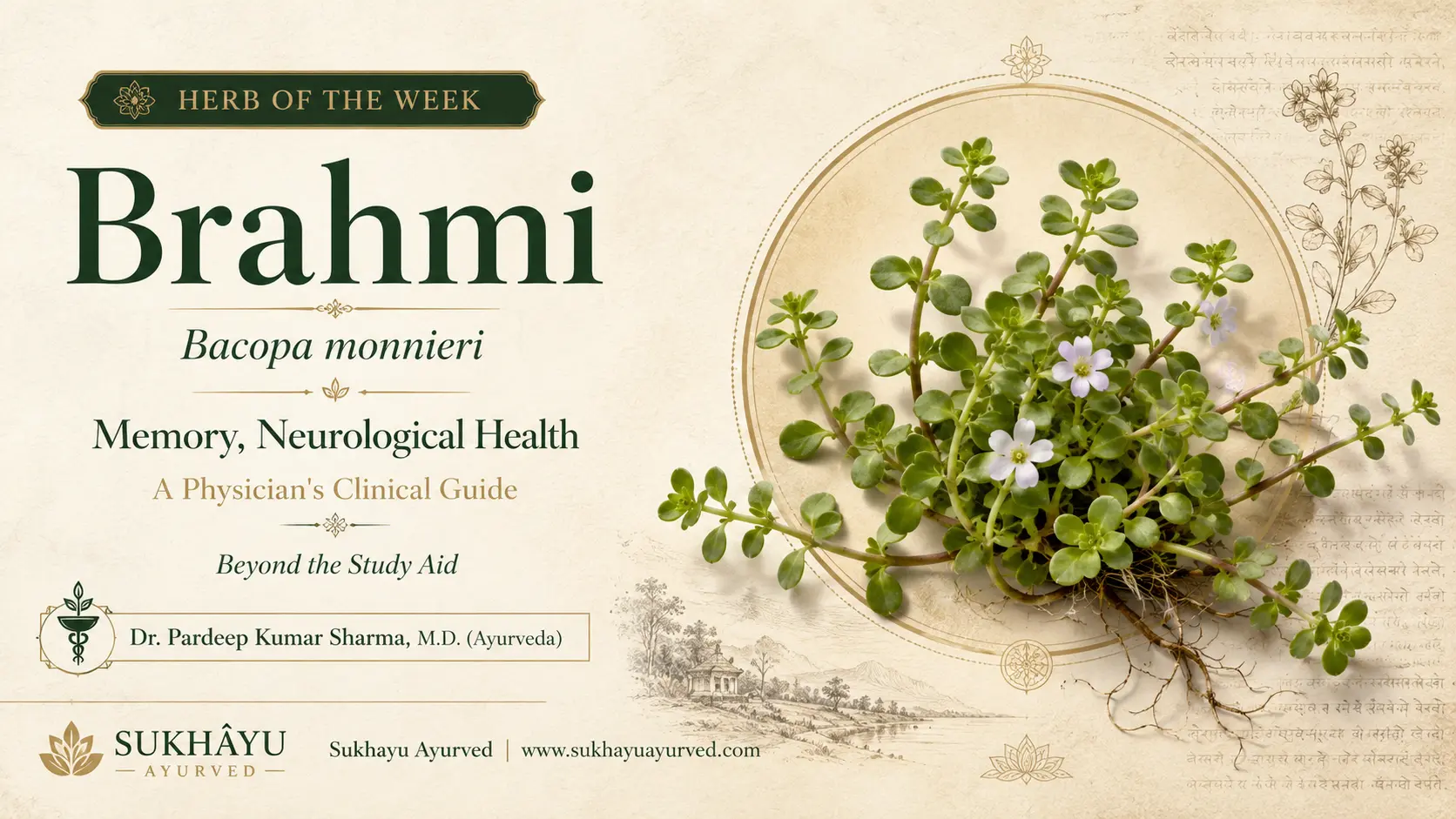
Open any classical formulary at the chapter on Medhya Rasayana and you will find Brahmi named in a single, famous line — one of four herbs the tradition set aside for the intellect. That one line has travelled further than almost any other in the whole materia medica. It is printed on supplement bottles, quoted in wellness blogs, repeated in advertisements for "brain tonics" and "study aids." A herb reduced to a headline.
But read past that line. Turn to the Nighantus — the Bhavaprakasha, the Dhanvantari, the Shodhala — the compendiums that physicians wrote across the centuries after Charaka, as they kept watching this plant work in real bodies. There, the same Brahmi is described doing far more than sharpening memory. Shopha — it reduces inflammatory swelling. Pandu — it acts in anaemia. Jwara — it works in fever. Kushtha and kandu — skin disease and itching. Pliha — disorders of the spleen. Meha — the diabetic spectrum. Dipani — it kindles the digestive fire. And yes, among all of this, medhya — it nourishes the intellect.
That is not the profile of a study aid. That is the profile of a wide-acting, cooling, Pitta-pacifying Rasayana whose effect on the mind — and on the wider spectrum of neurological conditions I treat — is one branch of a much larger tree.
So here is the question this article exists to answer: how did a herb this broad get shrunk to a nootropic? And what does it mean to prescribe it the way the whole tradition — not just one line of it — understood it?
The one line, and the thousand years after it
Charaka named Brahmi in the group of Medhya Rasayana, and I will say plainly: I keep Charaka's framing at the front of everything I do with this herb. When Charaka speaks, I treat it as settled ground. The boss, in my mind, is always right.
But being faithful to Charaka does not mean freezing the tradition at Charaka. The physicians who came after him did not close the book — they kept it open. Every later Nighantu that recorded a new action of Brahmi was doing exactly what a living science is supposed to do: observe more, record more, refuse to declare the subject finished. The Bhavaprakasha's jwarapaha, the Dhanvantari Nighantu's ayushya and vayah sthapani (life-promoting, age-arresting), the Shodhala Nighantu's jwarahari and tvak-doshahara — none of these contradict the Medhya identity. They extend it.
This is the part the supplement industry got wrong, and it got it wrong at a deeper level than commerce. It took one line of Charaka and slammed the horizon shut. It sold the memory and threw away the rest. But a science should not become a dogma. A dogma memorises one verse and stops. A science reads the verse, then keeps its eyes open for the next thousand years of observation. Ayurveda, at its best, was always the second kind.
That is the spirit in which I want you to read the rest of this piece — Charaka first, and then the open horizon Charaka's own tradition kept walking toward.
What I am actually treating when I prescribe Brahmi
Ask most people what Brahmi is for and they will say "memory." Ask me, after twenty years of writing it on prescriptions, and two answers come up long before memory does: fever, and the irritable gut.
Jwara — fever — is a priority use for me, and it is not an eccentric one. It sits right there in the classical action-list, named twice across the Nighantus. Brahmi is soumya and tikta — cooling and bitter — and that combination is exactly what a Pitta-driven, inflammatory febrile state needs.
But the use I reach for most, the one that surprises patients and even some colleagues, is IBS — irritable bowel syndrome. And to explain why Brahmi belongs there, I have to explain the thing that most Brahmi content never connects: the gut and the brain are not two problems. They are two ends of one axis.
The gut–brain link — one herb, both ends
Think of the IBS patient I see most often. The gut is not the whole story. Behind the loose, urgent, unpredictable bowel is an anxious, hypervigilant mind — the anticipatory dread before a meal, the flare that tracks a stressful week far more faithfully than it tracks any particular food. Treat only the gut in this patient and you are bailing water out of a boat while the leak stays open. The mind keeps driving the gut.
Now look at what Brahmi actually is. It is medhya, soumya, vayah sthapani — it cools and steadies an agitated, over-heated mind. And it is dipani and picchila — it kindles a disordered digestive fire while its mucilaginous, soothing quality settles the irritated gut lining. One herb reaching both ends of the same axis at the same time. It quiets the anxious mind that is driving the gut, and it soothes and re-orders the gut the mind has been inflaming.
This is the point I most want to land: the reason Brahmi works in IBS is the very same reason it is a Medhya Rasayana. Its digestive use and its cognitive use are not two unrelated entries on a list. They are one continuous action along the gut–brain axis. The tradition did not file "memory" and "digestion" in separate drawers — it understood a herb that touches the whole manas–agni continuum. The reductionists split what the classical physician kept whole.
And notice what this reveals about dipani. Brahmi is a Medhya herb that is not, by its own nature, strongly Ama-clearing — most Medhya dravyas aren't. But Brahmi's own agni-kindling quality makes it more forgiving in a compromised gut than the purely cooling Medhya herbs. That single property is a large part of why I trust it in the gut–brain patient where I would be far more cautious with others.
How I actually prescribe it
Here the internet is at its most reductive — "take Brahmi with X." Real prescribing does not work like that. The herb is largely the same; what changes is how it is delivered and in which direction you are driving it.
Brahmi Churna — I give it morning and evening, on an empty stomach.
Brahmi Ghrita — on an empty stomach.
The anupana, the vehicle it rides on, is not fixed to the herb. It is chosen for the purpose and the preparation — the direction of treatment decides the carrier, not the label on the jar. The same Brahmi churna can be pointed toward the mind, toward the gut, or toward cooling a Pitta-agitation, depending on what it is delivered with. That judgement is the physician's, made in front of the patient, not a formula to be copied off a page.
Which brings me to the most beautiful and least-marketed idea in the whole subject: yogavahi dravyas — the carriers that potentiate and direct a medicine without altering its own nature. Brahmi works wonders with them. Ghee and honey are the classical yogavahis, and Brahmi's soft, picchila, soumya character makes it an ideal substrate — it does not fight the carrier, it rides it to the tissue you are aiming for. Ghee to reach the Vata-gut and the neural tissue; honey as a finer vehicle of transport. In select cases that need to reach deeper into the dhatus, I will use it with Swarna Bhasma (gold) and Rajata Bhasma (silver) as the carrying agents.
I want to be equally honest about what I do not do: I do not reach for elaborate fixed combinations here. Brahmi, in my hands, largely stands on its own — delivered well, rather than compounded heavily. Delivery, not a longer ingredient list, is where the skill lies.
Because it is a Rasayana, it is not a burst-course herb. For genuine Rasayana benefit I use it regularly for six months and beyond. Rasayana rewards patience; it does not answer to a two-week trial.
Who Brahmi is not for — and the honest ceiling
Trust is built at the boundary, so let me draw mine clearly.
There are very few absolute contraindications to Brahmi. But I do not use it in two situations: stupor and schizophrenia. The reasoning is mechanistic, not arbitrary. Brahmi's whole action bends toward cooling and quieting. In a mind already sunk in stupor — a dulled, suppressed, tamas-heavy state — adding a calming, cooling agent pushes further in the wrong direction; you would be sedating an already-sedated consciousness. And schizophrenia is not a deficit of cognition or a simple excess of Pitta-heat that a Medhya herb can cool — it is a different order of pathology, and a Rasayana for the intellect is not the tool for it. "Good for the mind" is not the same as "good for every disorder of the mind." That distinction is the whole difference between a physician and a herb-seller.
There is a second limit, subtler and just as important — the terrain. A Medhya Rasayana works at the level of Majja and Manas, and it can only reach that level when the ground beneath is prepared: when Ama is cleared, Agni is kindled, and Vata is anulomita (moving in its proper downward direction). Given prematurely into a terrain of Ama and Mandagni — a clogged, cold, toxic digestive field — even the right herb misfires. I have written in detail elsewhere about exactly how this goes wrong when parents give Brahmi and Shankhpushpi to autistic children before the terrain is ready — the herb, given into the wrong ground, can worsen the very restlessness it was meant to calm. Brahmi is a finishing instrument in a well-prepared body, not a first-aid tonic to be dropped onto any complaint.
What this means, beyond the herb
The story of Brahmi is really a story about how we hold knowledge. One line of Charaka, memorised and sold, made Brahmi small. The centuries of observation that followed — and the clinic in front of me every morning — keep making it large again.
I hold both at once, and I do not find them in conflict. Reverence for the classical text and openness to the herb's full range are not opposites; they are the two hands of the same practice. Charaka is the boss, and the boss is always right — and the tradition Charaka founded was never meant to stop at Charaka. That is what a living science looks like: rooted, and still growing.
Cure is divine. Treatment is possible. The physician's work sits in between — to keep the old text open on the desk, and the horizon open beyond the window.
Dr. Pardeep Sharma, M.D. (Ayurveda) is the founder of Sukhayu Ayurved, Jaipur. With over 20 years of clinical experience in Ayurvedic management of orthopedic, neurological and autoimmune conditions.
Medical disclaimer: This article is for educational purposes and reflects clinical and classical understanding of Brahmi (Bacopa monnieri). It is not a substitute for individual medical advice. Herbs like Brahmi act differently depending on your constitution, your current state of Agni, and coexisting conditions and medications. Do not self-prescribe, especially in neurological or psychiatric illness or alongside prescription medication. Consult a qualified Ayurvedic physician before beginning any Rasayana.