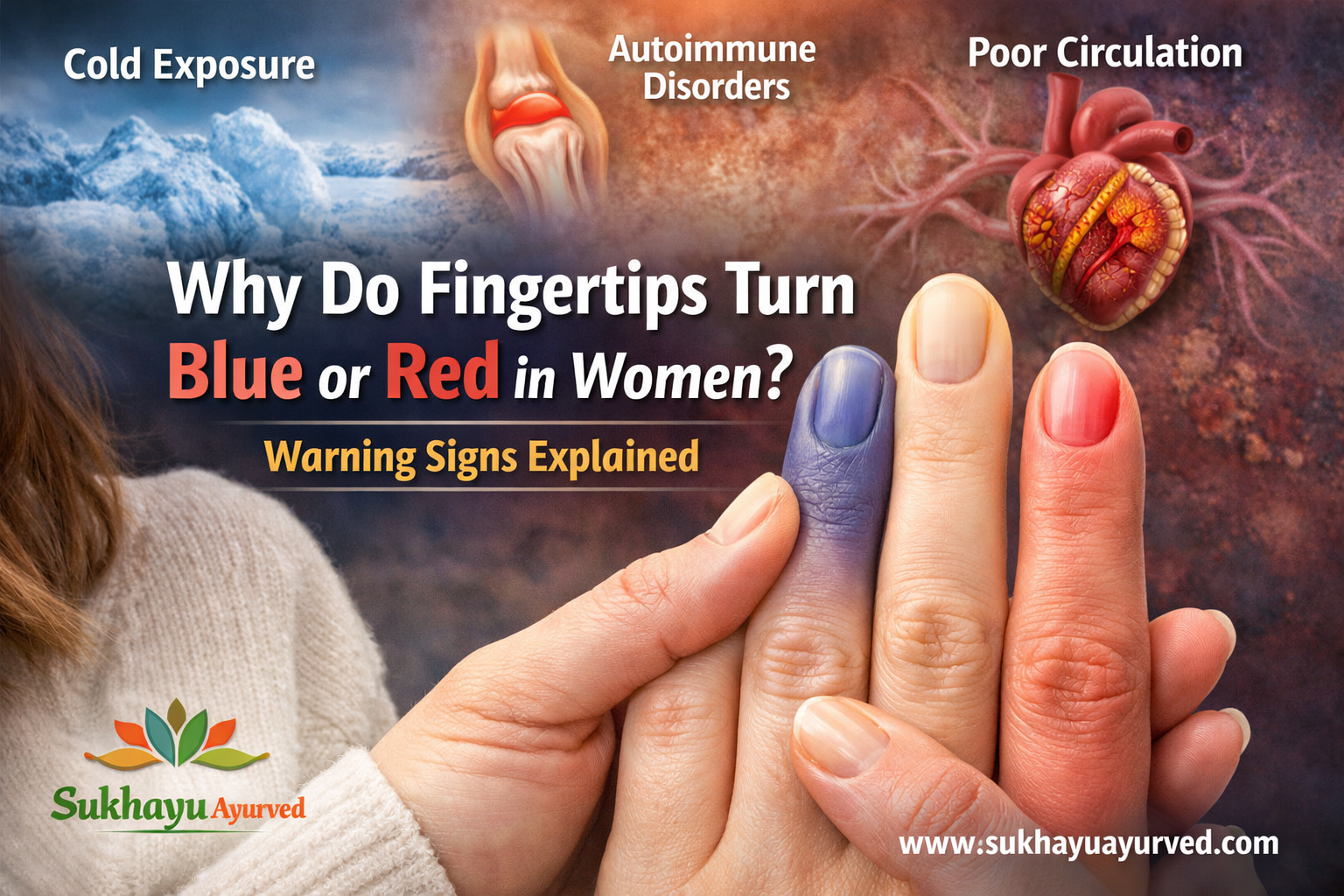
Body generally wishpers about the serious conditions through some symptoms. Generally these symptoms are neither loud enough to be alarmed nor painful enough to disrupt. This is the reason, patients generally ignore these symptoms, and when condition worsens further, these are shared while taking medical history.
Cold fingers.
A bluish tinge.
Sometimes turning pale, then suddenly red.
These are just normal conditions and they accept these conditions without checking the severity and reason behind these.
Most women brush it aside—
“Maybe it’s just the weather.”
“Poor circulation.”
“Nothing serious.”
But human body rarely speaks without an underlying reason.
And when it chooses the fingertips, it is often pointing toward something deeper—something systemic, something that deserves attention.
What Do Blue or Flushed Fingertips Actually Mean?
To understand this, we must first observe—not label.
Fingertips changing color is not a random occurrence. Finger tips have a dense network of arteries. This mesh colours the fingertips. When there is normal blood supply- things are normal- the colour will be pinkish or reddish. So the change in fingertips is a vascular phenomenon—a reflection of how blood is flowing (or not flowing) in the smallest vessels of the body.
Typically, three color changes may be observed:
- White (Pallor): Reduced blood flow due to sudden constriction of small vessels
- Blue (Cyanosis): Reduced oxygen supply in stagnant blood
- Red (Flushing): Sudden return of blood flow causing reactive dilation
This sequence—white to blue to red—is not just a visual pattern. It is a physiological story unfolding in real time.
Like a river that first dries, then becomes still and oxygen-deprived, and then suddenly floods.
The Most Common Explanation: Raynaud’s Phenomenon
One of the most frequent causes of such symptoms is a condition known as Raynaud’s phenomenon.
In simple terms, it is an exaggerated response of blood vessels to triggers like cold or stress.
Instead of gently adjusting, the vessels spasm sharply, cutting off blood flow temporarily.
When It Is Not “Just Raynaud’s”
This is where clinical responsibility begins, for both patients and physicians.
Because sometimes, these colour changes are not the condition—they are the first visible sign of something deeper.
The fingertips, in many ways, are like the edges of a map. When circulation begins to struggle, these are the first places to show it.
Conditions that may be associated:
- Autoimmune disorders
- Rheumatoid arthritis
- Systemic lupus erythematosus (SLE)
- Scleroderma
- Thyroid dysfunction
- Peripheral vascular disorders
- Drug-induced vascular changes
In such cases, what appears as a “simple colour change” may actually be the early language of immune dys-regulation or vascular compromise.
And this is where ignoring becomes risky.
As a patient- update immediately to your doctor.
An Ayurvedic Understanding: When Vata Constricts and Rakta Struggles
Ayurveda does not see this as a local event.
It sees it as a disturbance in the movement and nourishment systems of the body.
1. Vata Imbalance (Especially Vyana Vata)
Vata governs movement—of blood, impulses, and flow.
When aggravated, it behaves like a sudden gust of cold wind— causing constriction, irregularity, and instability.
This is reflected as:
- Sudden vasospasm
- Cold sensitivity
- Tingling or numbness
2. Rakta Dhatu Dushti (Impaired Blood Quality & Flow)
Rakta is not just blood—it is the carrier of life, warmth, and color.
When Rakta is disturbed:
- Discolouration appears
- Oxygenation becomes inefficient
- Skin loses its natural glow
3. Ama (Metabolic Toxins) and Microcirculation
When digestion (Agni) is weak, Ama forms.
Ama behaves like sludge— thick, sticky, and obstructive.
In microcirculation, this translates to:
- Sluggish flow
- Poor tissue nourishment
- Delayed recovery after vasospasm
💡 Think of it like oil trying to flow through a narrow pipe filled with residue. The flow is not smooth—it is interrupted.
Why Women Experience This More Frequently
This is not coincidence—it is physiology.
Women live in a more cyclical and responsive biological environment.
- Hormonal fluctuations influence vascular tone
- Immune responses tend to be more active (and sometimes overactive)
- Emotional processing and stress reactivity can influence Vata
Over time, small disturbances accumulate. And what begins as “just cold fingers” may slowly become:
- Frequent episodes
- Increased sensitivity
- Associated fatigue or joint issues
Many women normalize discomfort— until the body demands attention louder.
Symptoms You Should Not Ignore
Not every episode is serious.
But certain patterns should prompt evaluation:
- Repeated colour changes (especially white → blue → red sequence)
- Pain, numbness, or tingling in fingers
- Skin tightening or ulcer formation
- Increasing frequency or severity of episodes
- Associated symptoms like:
- Joint pain
- Fatigue
- Hair fall
- Dryness
If symptoms are evolving, this is no longer a cosmetic issue.
It is a clinical signal.
How Is This Evaluated?
A proper assessment does not begin with a label—it begins with listening to the pattern.Depending on presentation, evaluation may include:
- Detailed clinical history
- Blood investigations:
- ESR, CRP
- ANA profile (for autoimmune screening)
- Thyroid function tests
- In selected cases: nailfold capillaroscopy
The goal is not to “confirm Raynaud’s” alone. The goal is to understand whether this is isolated—or part of a larger systemic picture.
How Ayurveda Approaches This Condition
Ayurveda does not treat color.
It treats the terrain in which that color change occurs.
Core Principles of Management:
1. Pacifying Vata
Stabilizing the erratic movement that causes vasospasm.
2. Improving Microcirculation
Enhancing the smooth flow of Rakta in peripheral tissues.
3. Clearing Ama
Removing metabolic obstructions that impair circulation.
4. Nourishing Dhatus
Strengthening tissues so they respond better to environmental stress.
Therapeutic Approach (Individualised)
Depending on assessment, management may include:
- Snehana (Oleation therapies) to counter dryness and constriction
- Swedana (Sudation therapies) to improve peripheral circulation
- Basti (in selected cases) for deeper Vata regulation
- Rasayana support for long-term tissue nourishment
It is important to understand:
No single therapy works in isolation.
Treatment is layered, sequential, and tailored to the individual.
Diet and Lifestyle: The Real First-Line Treatment
Before medicines, before procedures—
the body responds to daily choices.
What Helps:
- Warm, freshly prepared meals
- Unctuous foods (adequate healthy fats)
- Regular eating timings (Agni stability)
- Gentle, consistent physical activity
What Aggravates:
- Cold exposure (especially hands and feet)
- Dry, processed, or stale food
- Irregular meals or excessive fasting
- Chronic stress and sleep disturbances
💡 A body that is constantly exposed to cold, irregularity, and dryness will naturally express Vata disturbances.
Simple Practices That Support Healing
- Keep extremities warm (gloves in cold weather)
- Daily Abhyanga (oil massage) to stabilize Vata
- Gentle breathing practices to regulate stress response
- Avoid sudden temperature transitions
These are not “small tips.”
They are foundational corrections.
Precautions (Must Read)
- Do not ignore persistent or worsening symptoms
- Avoid self-diagnosing as “just poor circulation”
- Seek medical evaluation if:
- Episodes increase in frequency
- Pain or ulcers develop
- Systemic symptoms are present
⚠️ Disclaimer:
This information is for educational purposes only. Diagnosis and treatment should always be guided by a qualified medical practitioner after proper evaluation. Self-treatment, especially in suspected autoimmune or vascular conditions, may delay appropriate care.
Listening to the Whisper
The body does not fail suddenly.
It gives signs.
Subtle. Repetitive. Patient.
Blue fingertips.
Cold sensitivity.
Color changes that come and go.
These are not inconveniences.
They are conversations.
And healing begins—not when the symptom becomes severe—but when the whisper is finally heard.