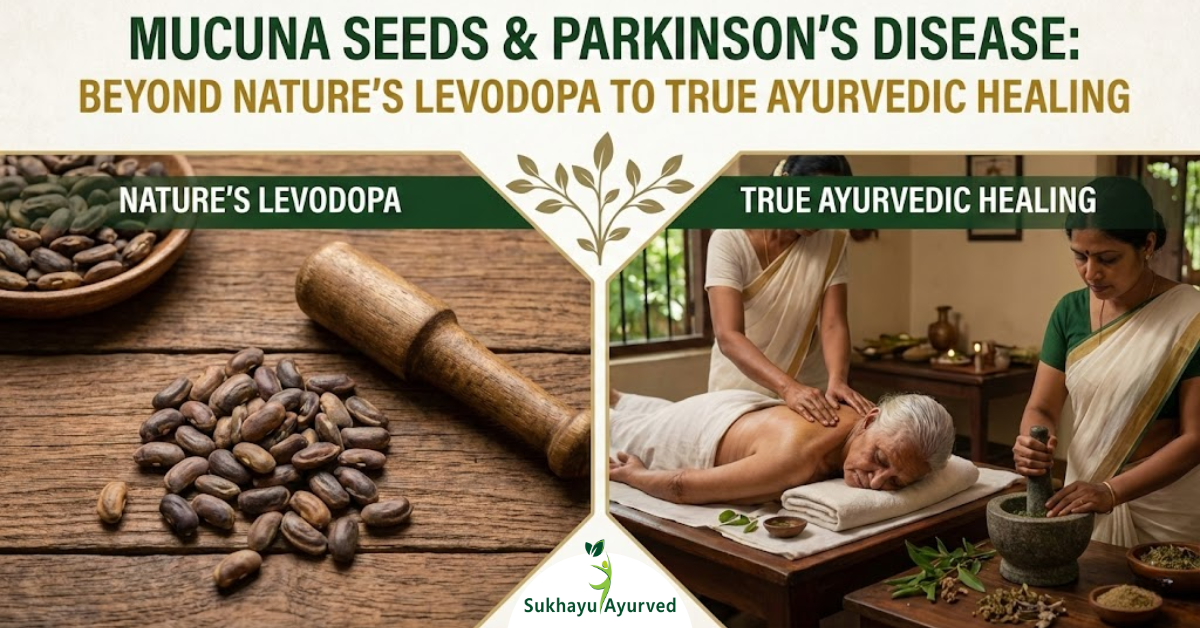
If you or someone you love has been diagnosed with Parkinson's disease, you know the journey that follows—the tremors that start subtly, the stiffness that spreads into daily movements, the medications that help but come with their own challenges. And if you've been researching natural alternatives, you've probably come across Mucuna pruriens, often called "nature's Levodopa."
It sounds promising, doesn't it? A natural seed that contains the same active compound as the primary Parkinson's medication. But what if this 'natural swap' is missing the entire point of Ayurveda—and potentially a more profound opportunity for healing? And where we need to have an honest conversation about what "natural" really means, and more importantly, what Ayurveda actually offers beyond just swapping synthetic pills for herbal ones.
Let me take you on a journey that goes deeper than the surface-level understanding of Mucuna seeds. Because while these remarkable seeds do contain natural Levodopa, using them simply as a plant-based replacement for pharmaceutical Levodopa isn't truly Ayurvedic medicine—it's what practitioners like me call "herbal allopathy." And there's a profound difference.
The Parkinson's Puzzle: Why People Are Looking Beyond Conventional Treatment
Parkinson's disease affects nearly 10 million people worldwide, and that number is growing. It's a progressive neurological condition where the brain gradually loses its ability to produce or react to dopamine, a crucial neurotransmitter that helps control movement, coordination, and even mood.
The conventional treatment approach is- Levodopa (L-DOPA), which the brain converts into dopamine. It works—often remarkably well at first. But anyone who's been on this medication for a while knows the story: the honeymoon period eventually ends. The medication's effectiveness can wane over time, requiring higher doses.
Side effects emerge.
The "on-off" periods become more pronounced, where the medication works beautifully one moment and seems to vanish the next.
This is why so many people start searching for alternatives. Not necessarily to replace their medications entirely (though some hope for that), but to find something more sustainable, something that addresses the deeper issues, something that might slow the progression rather than just managing symptoms.
And this search often leads to Mucuna pruriens.
Meet Mucuna Pruriens: The Velvet Bean with Ancient Roots
Mucuna pruriens goes by many names—velvet bean, cowhage, and in Ayurveda, Krauncha or Kapikacchu (sometimes spelled Kapikachu). It's a tropical legume with distinctive fuzzy pods that have been used in traditional medicine systems for thousands of years.
Here's what makes it so interesting for Parkinson's: these seeds naturally contain L-DOPA, the same compound found in the primary medication for Parkinson's disease. In fact, they can contain anywhere from 3-7% L-DOPA by weight, which is substantial.
Research has shown that Mucuna seed powder can be as effective as synthetic Levodopa in managing Parkinson's symptoms, sometimes with fewer side effects and a longer duration of action. Some studies suggest it might even work faster and produce smoother motor responses. That's genuinely exciting, and it's no wonder people get enthusiastic about it.
In traditional Ayurvedic texts, Kapikacchu has been praised for centuries—but not specifically for Parkinson's disease as we know it today. It was valued as a powerful nervine tonic, an aphrodisiac, a strength-builder, and a rejuvenate. It was used for various Vata disorders, for building reproductive tissue, for enhancing vitality, and for supporting the nervous system broadly.
The ancient physicians didn't know about dopamine or Levodopa. They didn't need to. They understood this plant through a completely different lens—one that saw the whole person, not just isolated neurotransmitters.
The Ayurvedic Understanding: Parkinson's as Kampavata
In Ayurveda, what we call Parkinson's disease most loosely resembles a condition called Kampavata.
Let's break down what this means, because understanding the Ayurvedic perspective is crucial to understanding why simply taking Mucuna seeds isn't the complete answer.
"Kampa" means tremor or shaking. "Vata" is one of the three fundamental energies (doshas) in Ayurveda, governing all movement in the body—from the blinking of your eyes to the firing of neurons, from the beating of your heart to the movement of your limbs.
When Vata becomes severely imbalanced and aggravated, it can create tremors, rigidity, and movement difficulties. But here's the key insight that Ayurveda adds: in Kampavata, this Vata disturbance is often complicated by Kapha blockage. Kapha, another dosha, represents structure, lubrication, and stability. When Kapha accumulates and blocks the channels (srotas) through which Vata should flow smoothly, you get the characteristic symptoms of Parkinson's.
Think of it like this: imagine Vata as wind trying to move through passages in the body. When those passages are clear, movement is smooth and coordinated. But when Kapha—which is heavy, sticky, and obstructive—blocks those channels, the wind becomes erratic, creating tremors, stiffness, and difficulty initiating movement.
The Ayurvedic texts also recognize that Kampavata involves the deterioration of Majja dhatu (the nervous tissue) and affects Manovaha srotas (the channels carrying mental and nervous impulses). There's often an involvement of ama (toxic accumulation) and a depletion of Ojas (the subtle essence of vitality and immunity).
This is a completely different framework from "dopamine deficiency," isn't it? It's not that one is right and the other wrong—they're different ways of understanding the same phenomenon. But this difference in understanding leads to a radically different approach to treatment.
The "Herbal Allopathy" Trap: Why Natural Levodopa Isn't Truly Ayurvedic
Now we come to the heart of the matter, and this might challenge some assumptions.
When someone takes Mucuna pruriens simply because it contains natural L-DOPA, using it in the same way they'd use pharmaceutical Levodopa—same logic, same approach, just a different source—that's not really Ayurvedic medicine. It's what some practitioners call "herbal allopathy" or "green allopathy."
Let me explain what I mean.
Allopathic medicine (conventional Western medicine) operates on a specific paradigm: identify the deficiency or malfunction, and supply what's missing or suppress what's excessive. Dopamine is low? Supply Levodopa so the brain can make more dopamine. It's logical, direct, and often effective in the short term.
Using Mucuna seeds in exactly the same way—taking them primarily for their L-DOPA content to boost dopamine levels—follows the exact same logic. The only difference is the source is natural rather than synthetic.
You're still treating a disease, a diagnosis, a deficiency. You're not treating a person.
And that's the fundamental difference.
True Ayurvedic medicine doesn't treat diseases—it treats people who have diseases. It doesn't just address deficiencies—it asks why those deficiencies arose in the first place. It doesn't simply supply what's missing—it restores the body's ability to maintain its own balance.
When an Ayurvedic physician looks at someone with Parkinson's Disease, they're not just seeing "low dopamine." They're seeing a unique individual with a specific constitution (Prakriti), a particular pattern of imbalance (Vikriti), a personal history, a digestive capacity, a mental-emotional state, a lifestyle, and a complex interplay of doshas, dhatus, and srotas.
They're asking questions like:
- What caused the Vata to become so severely aggravated?
- Where is the Kapha blocking the channels, and why?
- How is the digestive fire (Agni), and is it creating ama?
- What's the state of the nervous tissue (Majja dhatu)?
- How depleted is the person's Ojas?
- What's their mental and emotional state (Manas prakriti)?
- What dietary and lifestyle factors are contributing?
The treatment that emerges from these questions is necessarily personalized, multifaceted, and aimed at the root causes—not just symptom suppression.
This doesn't mean Mucuna pruriens isn't used in Ayurvedic treatment of Kampavata. It often is! But it's used as part of a comprehensive approach, in specific formulations, combined with other herbs, at particular times, and always within the context of addressing the whole person.
What True Ayurvedic Treatment Actually Looks Like
So if simply taking Mucuna seeds for their L-DOPA content isn't the Ayurvedic approach, what is? Let me paint you a picture of what comprehensive Ayurvedic treatment for Kampavata actually involves.
The Foundation: Understanding Your Unique Constitution
Everything begins with a thorough assessment. An Ayurvedic practitioner will spend considerable time understanding your constitution—both your natural state (Prakriti) and your current imbalanced state (Vikriti). They'll examine your pulse in detail, observe your tongue, ask about your digestion, sleep, energy patterns, mental state, and life circumstances.
This isn't just gathering information—it's understanding the unique terrain of your body and mind, so treatment can be precisely tailored to you, not to "Parkinson's disease" in general.
Panchakarma: Deep Cleansing and Rejuvenation
For many people with Kampavata, especially in earlier stages, Panchakarma—Ayurveda's profound detoxification and rejuvenation therapy—forms a crucial part of treatment.
Panchakarma isn't a single treatment but a carefully orchestrated series of therapies designed to remove deep-seated toxins (ama) and excess doshas from the body. For Kampavata, this typically includes:
Snehana (oleation therapy): This involves both internal consumption of medicated ghee and external oil massage. The oils used aren't random—they're specifically chosen based on your constitution and condition. For Vata disorders affecting the nervous system, oils like Mahanarayan oil, Dhanwantaram oil, or Bala oil might be used. These oils are infused with dozens of herbs that nourish the nervous tissue, calm Vata, and penetrate deep into the channels.
The internal oleation is particularly important. Taking medicated ghee for several days before the main cleansing procedures helps loosen toxins from deep tissues and makes them mobile so they can be eliminated. It also nourishes the nervous system from within.
Swedana (therapeutic sweating):
After oleation, controlled sweating therapies help further loosen toxins and open the channels. For Vata conditions, this is done gently—not aggressive steaming, but mild, nourishing warmth.
Virechana (therapeutic purgation):
This is a controlled, medicated purgation that eliminates excess Pitta and Kapha from the body. It's not like taking a harsh laxative—it's a carefully timed, precisely dosed procedure using herbal preparations that cleanse the GI tract and, through it, the entire system.
Basti (medicated enema therapy):
This is considered the most important treatment for Vata disorders. Basti involves administering herbal decoctions and oils through the rectum, which might sound unusual, but the colon is considered the primary seat of Vata. By treating Vata at its source, Basti can have profound effects on the entire nervous system.
For Kampavata, special Bastis using nervine herbs and nourishing oils are used. These might include herbs like Ashwagandha, Bala, Shatavari, and yes, sometimes Kapikacchu, along with sesame oil or other medicated oils.
Nasya (nasal administration):
The nose is considered the gateway to the head and brain. Administering medicated oils through the nasal passages can directly affect the nervous system, clear the channels in the head, and nourish the brain tissue.
A full Panchakarma course might last anywhere from two to four weeks, and it's not something you do once and forget. Many people with chronic conditions like Kampavata benefit from periodic Panchakarma treatments—perhaps annually or bi-annually—to maintain the benefits and prevent further deterioration.
Herbal Formulations: Beyond Single Herbs
Now we come back to herbs, but with a completely different approach than just taking Mucuna seeds.
In classical Ayurveda, herbs are rarely used alone. They're combined in specific formulations where each herb plays a role—some are the main therapeutic agents, others enhance absorption, some prevent side effects, others direct the formula to specific tissues or organs.
For Kampavata, there are classical formulations that have been used for centuries. These might include:
Formulations containing Kapikacchu (Mucuna): Yes, Mucuna is used, but typically in combination with other herbs. It might be combined with Ashwagandha (for nervous system strength), Bala (for Vata pacification), Shatavari (for nourishment), Gokshura (for nerve support), and others. The formula is balanced to not just supply L-DOPA but to strengthen the entire nervous system, improve digestion, clear channels, and build vitality.
Nervine tonics and Rasayanas:
Herbs like Brahmi (Bacopa monnieri), Shankhapushpi, Jatamansi, and Ashwagandha support cognitive function, calm the mind, and nourish nervous tissue. These aren't treating dopamine deficiency—they're supporting the overall health and resilience of the nervous system.
Digestive support:
Remember, Ayurveda sees strong digestion (Agni) as the foundation of health. Herbs like Trikatu (three pungents), Hingvastak churna, or other digestive formulations ensure that whatever you're taking is properly absorbed and doesn't create more ama.
Vata-pacifying formulations:
Classical preparations like Dashamoola (ten roots), Maharasnadi kashayam, or Ashwagandharishta help calm aggravated Vata throughout the system.
The specific formulations used depend entirely on the individual assessment. Two people with Parkinson's might receive quite different herbal protocols based on their unique presentations.
Diet and Lifestyle: The Daily Medicine
In Ayurveda, food isn't just fuel—it's medicine. And for Vata disorders like Kampavata, diet is absolutely crucial.
The general principle is to favor foods that are warm, moist, grounding, and nourishing—qualities that oppose Vata's cold, dry, light, and mobile nature. This typically means:
- Warm, cooked foods rather than raw or cold foods
- Healthy fats like ghee, sesame oil, and olive oil
- Whole grains like rice, oats, and wheat
- Cooked vegetables, especially root vegetables
- Warming spices like ginger, cumin, cinnamon, and cardamom
- Adequate protein from sources like mung beans, dairy (if tolerated), and for non-vegetarians, well-cooked meat
- Avoiding or minimizing cold, dry, light foods; excessive raw foods; and stimulants like caffeine
But it's not just what you eat—it's how you eat. Regular meal times, eating in a calm environment, chewing thoroughly, and not eating when stressed or upset all matter tremendously for Vata balance.
Lifestyle modifications are equally important:
Regular routine:
- Vata thrives on regularity. Going to bed and waking at consistent times, eating at regular hours, and having a predictable daily rhythm all help calm Vata.
Adequate rest:
- Quality sleep is crucial for nervous system health. Ayurveda has specific recommendations for improving sleep, including evening oil massage, warm milk with nutmeg, and calming bedtime routines.
Gentle, regular exercise:
- Not intense, depleting exercise, but gentle, grounding practices like walking, swimming, or tai chi. Yoga, particularly gentle, restorative styles, can be especially beneficial.
Stress management:
- Chronic stress aggravates Vata tremendously. Practices like meditation, pranayama (breathing exercises), and spending time in nature all help.
Oil massage (Abhyanga):
- Daily self-massage with warm sesame oil or other Vata-pacifying oils is one of the most powerful Vata-balancing practices. It nourishes the skin (which is related to the nervous system), calms the mind, and grounds the energy.
Warmth:
- Keeping warm, avoiding cold and wind, and using warm baths or showers all help pacify Vata.
These aren't minor additions to treatment—they're fundamental. In fact, without proper diet and lifestyle, even the best herbs and therapies will have limited effect.
Specific Therapies for Nervous System Support
Beyond the general Panchakarma treatments, there are specific therapies particularly beneficial for neurological conditions:
Shirodhara:
This is the famous therapy where a continuous stream of warm oil is poured over the forehead for an extended period. It's deeply calming to the nervous system, helps with tremors, improves sleep, and creates a profound sense of peace. For people with Kampavata, regular Shirodhara treatments can be remarkably beneficial.
Shirobasti:
In this therapy, a reservoir is created on the head and filled with warm medicated oil, which sits on the scalp for a period of time. It's more intensive than Shirodhara and is used for more severe nervous system conditions.
Pizhichil:
This involves a continuous stream of warm oil being poured over the body while simultaneously being massaged. It's deeply nourishing for Vata and the nervous system.
Navarakizhi:
A therapy using boluses of rice cooked in milk and herbs, applied to the body. It's strengthening and nourishing, particularly good for building tissue and vitality.
These therapies aren't just pleasant spa treatments—they're powerful medical interventions that work on subtle levels to rebalance the nervous system.
Rasayana: The Rejuvenation Phase
After cleansing and balancing, Ayurveda emphasizes Rasayana—rejuvenation therapy. This is about rebuilding strength, vitality, and resilience.
For Kampavata, this might involve specific Rasayana herbs and formulations designed to rejuvenate nervous tissue, build Ojas (vital essence), and create long-term stability. This phase might last several months and is crucial for preventing further deterioration.
Rasayana isn't just about taking herbs—it's a whole lifestyle approach that includes optimal diet, adequate rest, positive mental states, and practices that build vitality rather than deplete it.
The Mental and Spiritual Dimension
Ayurveda recognizes that the mind and body are inseparable. Parkinson's often comes with depression, anxiety, and cognitive changes—not just as side effects of the disease, but as integral parts of the imbalance.
True Ayurvedic treatment addresses the mental and emotional dimensions through:
Meditation and mindfulness practices:
- These calm the mind, reduce stress, and can actually affect nervous system function.
Pranayama (breathing practices):
- Specific breathing techniques can calm Vata, energize the system, and improve mental clarity.
Mantra and sound therapy:
- The use of specific sounds and mantras can have profound effects on the nervous system and mental state.
Counseling and lifestyle guidance:
- Understanding the disease from an Ayurvedic perspective, learning to work with your body rather than against it, and developing a positive relationship with the healing process.
Spiritual practices:
- For those who are inclined, connecting with something larger than oneself, cultivating gratitude, and finding meaning can be powerful aspects of healing.
The Integration Question: Can Ayurveda Work Alongside Conventional Treatment?
Here's a question that comes up constantly: "Can I do Ayurvedic treatment while still taking my Parkinson's medications?"
The answer, in most cases, is yes—and in fact, this is often the most practical approach, especially for people who have been on medications for a while.
Ayurveda isn't inherently opposed to conventional medicine. The goal isn't necessarily to immediately stop all medications (though some people eventually reduce or eliminate them under proper guidance). The goal is to address the underlying imbalances, support overall health, and potentially slow or halt progression.
Many people find that with comprehensive Ayurvedic treatment, their medication needs stabilize or even decrease over time. The quality of their "on" periods improves. Side effects diminish. Overall vitality increases. Even if they continue needing some medication, their quality of life improves significantly.
However, this integration needs to be done carefully and under proper supervision. Some herbs can interact with medications. Dosages may need adjustment as the body's balance improves. This is why working with both a knowledgeable Ayurvedic practitioner and a neurologist who's open to integrative approaches is ideal.
A Word About Expectations and Timelines
I want to be honest with you about something important: Ayurvedic treatment for a condition like Kampavata isn't a quick fix. It's not about taking a supplement for a few weeks and expecting dramatic changes.
Parkinson's disease develops over years, often decades, before symptoms become apparent. The imbalances that led to it are deep-rooted. Reversing or even stabilizing such a condition takes time, patience, and consistent effort.
Some people notice improvements relatively quickly—better sleep, improved digestion, more energy, reduced anxiety. These are signs that the treatment is working, even if the tremors or rigidity haven't changed much yet.
More significant changes in motor symptoms typically take longer—months to years of consistent treatment. And the goal isn't always complete reversal (though this occasionally happens, especially in earlier stages). Often, the realistic goal is stabilization—preventing further deterioration, maintaining function, improving quality of life.
This requires a shift in mindset from the conventional medical model where you take a pill and expect immediate symptom relief. Ayurvedic healing is more like tending a garden—you prepare the soil, plant the seeds, water regularly, remove weeds, and gradually, over time, things grow and flourish.
It requires commitment, patience, and trust in the process.
The Practitioner Matters
One more crucial point: the quality of Ayurvedic treatment depends enormously on the practitioner.
Ayurveda is a complex, sophisticated medical system that takes years to master. A well-trained Ayurvedic physician (Vaidya) has studied for years, understands the classical texts, knows how to assess individuals accurately, and can create truly personalized treatment protocols.
Unfortunately, with the growing popularity of Ayurveda, there are also many people offering "Ayurvedic" treatments with minimal training. Someone who's taken a weekend workshop on Ayurvedic herbs isn't qualified to treat a complex neurological condition.
If you're considering Ayurvedic treatment for Parkinson's, seek out a properly qualified practitioner—ideally someone with minimum a BAMS degree (Bachelor of Ayurvedic Medicine and Surgery) or equivalent, with experience treating neurological conditions. Ask about their training, their experience with Kampavata specifically, and their approach to treatment.
A good practitioner will:
- Spend significant time on initial assessment
- Create a personalized treatment plan
- Explain their reasoning and approach
- Monitor your progress regularly and adjust treatment as needed
- Work collaboratively with your other healthcare providers
- Be honest about what Ayurveda can and cannot do
- Never ask you to immediately stop necessary medications without proper supervision
Beyond Mucuna: The Bigger Picture
So we've come full circle, back to where we started—with Mucuna pruriens, nature's Levodopa.
Is Mucuna useful for Parkinson's? Absolutely. The research supports it, and traditional use validates it. Can it help manage symptoms? Yes, often quite effectively.
But is taking Mucuna seeds for their L-DOPA content the Ayurvedic approach to Kampavata? No. It's one small piece of a much larger, more comprehensive, more personalized approach.
The difference is like the difference between putting a bandage on a wound versus understanding why the wound occurred, cleaning it properly, supporting the body's healing mechanisms, preventing infection, ensuring proper nutrition for tissue repair, and taking steps to prevent future wounds.
Both approaches might help the immediate problem, but only one addresses the deeper issues and creates lasting change.
Conclusion: Treating the Person, Not Just the Disease
Ayurveda's greatest gift isn't any single herb or treatment—it's a completely different way of understanding health and disease.
Where conventional medicine sees Parkinson's disease as a dopamine deficiency requiring dopamine replacement, Ayurveda sees a unique individual with a complex pattern of imbalances that manifested as Kampavata. Where conventional medicine treats the disease, Ayurveda treats the person who has the disease.
This isn't just philosophical—it has profound practical implications.
It means that two people with the same diagnosis might receive completely different treatments based on their unique constitutions, imbalances, and circumstances. It means that treatment addresses not just symptoms but root causes. It means that the goal isn't just symptom management but restoration of balance and vitality.
It means that you're not just a passive recipient of treatment but an active participant in your healing journey, making daily choices about diet, lifestyle, and self-care that profoundly affect your wellbeing.
For someone dealing with Parkinson's disease, this approach offers something that conventional medicine often doesn't: hope not just for symptom management but for genuine healing, for improved quality of life, for slowing or even halting progression.
Does this mean everyone with Parkinson's should abandon conventional treatment and pursue only Ayurveda? Not necessarily. The most practical approach for many people is integration—using the best of both systems, under proper guidance.
But it does mean that if you're considering Ayurvedic treatment, understand what you're really getting into. It's not about finding a natural substitute for your medications. It's about embarking on a comprehensive healing journey that addresses your whole being—body, mind, and spirit.
It requires commitment, patience, and trust. It requires finding a qualified practitioner. It requires making changes in your daily life. It requires seeing yourself not as a disease to be managed but as a person to be healed.
And that shift in perspective—from disease management to holistic healing, from treating symptoms to addressing root causes, from passive patient to active participant—might be the most powerful medicine of all.
If you're dealing with Parkinson's disease, whether you're newly diagnosed or have been living with it for years, know that you have options beyond the conventional path. Ayurveda offers a time-tested, comprehensive approach that honors your uniqueness and supports your body's innate healing wisdom.
Mucuna seeds might be part of that approach—but they're just one thread in a rich tapestry of healing practices that Ayurveda offers. The real medicine isn't in any single herb or treatment—it's in the holistic, personalized, root-cause-focused approach that sees and treats you as a whole person.
And that's what true Ayurvedic medicine is all about.
If the holistic, person-centered approach of Ayurveda resonates with you, the next step is to seek a qualified consultation. Look for a practitioner experienced in neurological conditions who will take the time to understand your unique story.