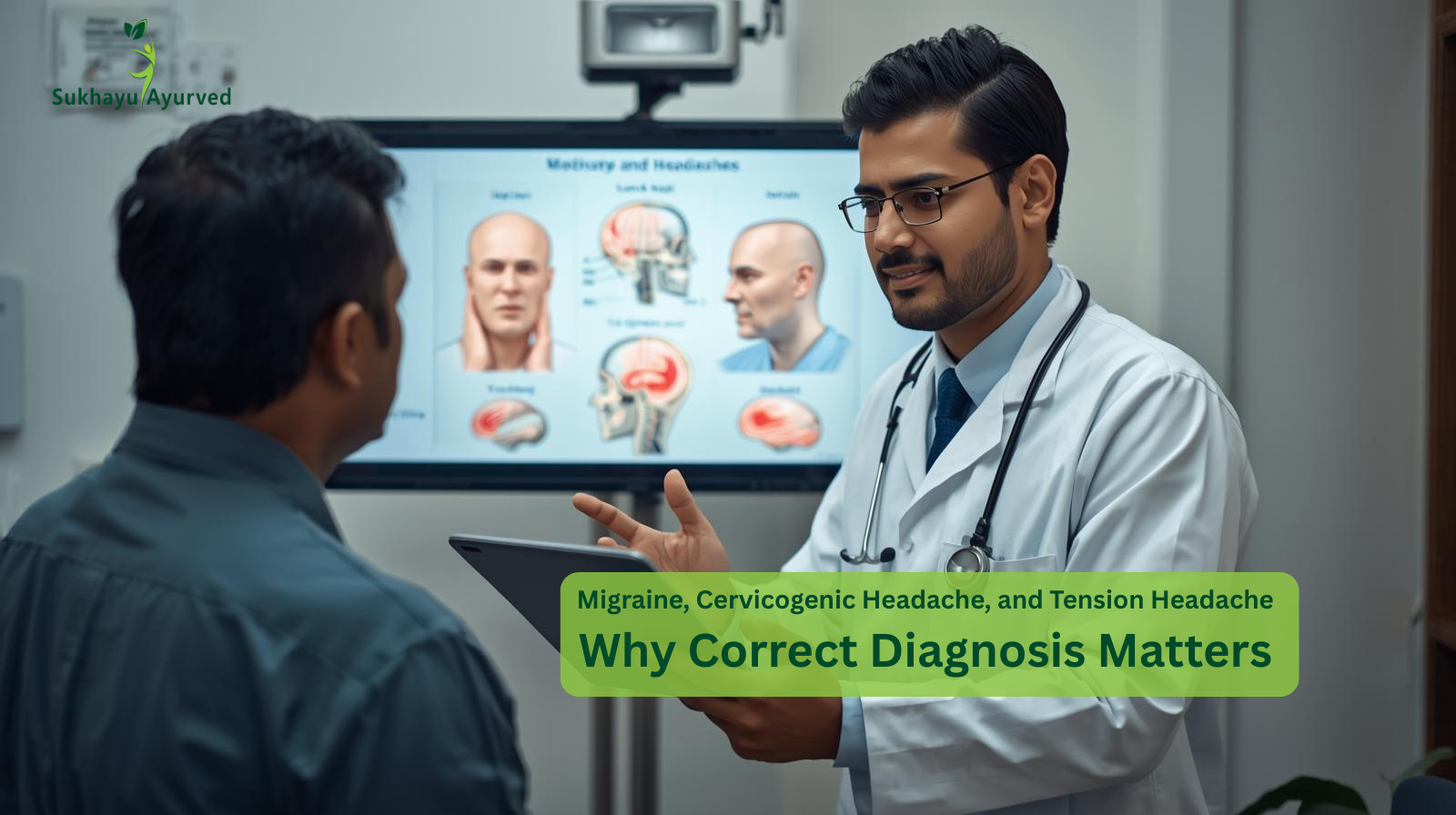
When All Headaches Are Labelled “Migraine”
Headache is one of the most common reasons patients seek medical help.
Yet, in clinical practice, a large number of people with recurring head pain are simply told they have “migraine”—often without a detailed evaluation.
Over time, this leads to frustration.
Medications may offer partial relief, symptoms keep returning, and patients begin to wonder whether the diagnosis itself is correct. In reality, not all headaches are migraines, and treating different headache types with the same approach can lead to poor outcomes.
This article explains the key differences between migraine, cervicogenic headache, and tension-type headache, and why accurate diagnosis is often more important than choosing a treatment modality.
Who This Article Is For — and Who It Is Not
This article is for:
- Patients with recurrent or chronic headaches
- Individuals who have tried multiple treatments with limited success
- People unsure whether their headache is truly a migraine
- Caregivers seeking clarity before long-term medication use
This article is not for:
- Sudden, severe “worst headache of life”
- Headaches associated with trauma, fever, seizures, or neurological deficits
- Emergency conditions such as stroke or brain infection
Any red-flag symptoms require immediate medical attention.
Why Headache Diagnosis Is Often Oversimplified
Headache is a symptom—not a diagnosis.
In busy clinical settings, headaches are often categorised quickly based on:
- Pain intensity
- Frequency
- Associated nausea or sensitivity to light
While this approach may help in acute management, it can miss important distinguishing features that point toward different headache mechanisms.
Misclassification can result in:
- Inappropriate long-term medication use
- Persistent symptoms
- Overlooking correctable causes such as neck dysfunction or muscle imbalance
Understanding the type of headache is the first step toward rational management.
Understanding the Three Common Headache Types
1. Migraine Headache
Migraine is a neurological disorder, not just a severe headache.
Common features include:
- Throbbing or pulsating pain, often one-sided
- Nausea or vomiting
- Sensitivity to light, sound, or smells
- Visual disturbances or aura in some cases
- Attacks lasting hours to days
Migraine involves altered brain excitability and pain processing. Structural imaging is usually normal.
2. Cervicogenic Headache
Cervicogenic headache originates from the neck and cervical spine, not the brain.
Key features:
- Pain starting in the neck and radiating to the head
- Often one-sided but consistent on the same side
- Aggravated by neck movement or posture
- Associated with neck stiffness or restricted movement
Cervicogenic headaches are commonly misdiagnosed as migraine because head pain is the dominant symptom.
3. Tension-Type Headache
Tension headache is the most common and often the least recognised properly.
Typical characteristics:
- Dull, pressing, or band-like pain
- Usually bilateral
- Mild to moderate intensity
- No nausea or severe sensitivity to light
- Often associated with stress, posture, or muscle tension
Despite the name, it is not “just stress”—muscle and nervous system factors play a role.
Why Imaging and Tests Are Often Normal
In most primary headache disorders:
- MRI and CT scans are normal
- Blood tests may be unremarkable
This does not mean the headache is imaginary.
Headache disorders often involve:
- Functional changes in nerves
- Muscular tension patterns
- Pain modulation pathways
- Postural and biomechanical stress
Diagnosis relies heavily on clinical history and examination, not just reports.
How Ayurveda Interprets Different Headache Patterns
Ayurveda does not classify all headaches under a single label.
Instead, it assesses:
- Nature of pain
- Triggers and relieving factors
- Associated digestive, sleep, and stress patterns
- Individual constitution and adaptability
This allows differentiation between headache patterns that may look similar superficially but behave very differently clinically.
Importantly, Ayurveda does not replace neurological diagnosis—it adds a functional and systemic perspective to symptom evaluation.
What Ayurveda Can Help With — and What It Cannot
Clear boundaries are essential.
Ayurveda may help with:
- Functional headaches linked to posture, muscle tension, or lifestyle factors
- Supporting nervous system balance
- Reducing frequency or intensity in selected chronic cases
- Complementary care alongside conventional treatment
Ayurveda cannot replace:
- Emergency evaluation for red-flag headaches
- Acute management of severe neurological events
- Necessary pharmacological treatment where clearly indicated
Any responsible approach must prioritise patient safety.
Why Correct Diagnosis Changes Everything
When headache type is correctly identified:
- Treatment becomes targeted
- Unnecessary medications can often be avoided
- Expectations become realistic
- Long-term outcomes improve
Treating all headaches as migraines often leads to treatment fatigue rather than resolution.
Safety, Expectations, and Clinical Boundaries
It is important to understand:
- Headache disorders are often chronic and episodic
- Improvement is usually gradual
- Complete elimination may not always be possible
- Ongoing evaluation is essential
- Multiple systems may need to be addressed
No system of medicine should promise instant or permanent results for chronic headache conditions.
When Should You Seek Further Evaluation?
Consider comprehensive evaluation if:
- Headaches are increasing in frequency or severity
- Pain pattern has changed
- Neck pain or stiffness is prominent
- Medications are required frequently
- Headaches affect daily functioning or sleep
Seek urgent care if headaches are sudden, severe, or accompanied by neurological symptoms.
A Thoughtful Clinical Perspective
Headaches are complex, and their management begins with understanding the source, not just suppressing the symptom.
When diagnosis is precise, treatment—whether conventional, integrative, or supportive—becomes more rational and effective.