Every few years, a headline resurfaces: an Ayurvedic product bought somewhere abroad was tested and found to contain lead, or mercury, or arsenic. The story spreads, the fear spreads faster, and patients who were doing well on treatment arrive in my clinic asking whether they have been quietly poisoning themselves.
It is a fair question, and it deserves a fair answer — not a defensive one, and not a dismissive one. So let me give you the honest version, the one I give across the desk.
There is an old saying that medicine and poison differ only in dosage. To that I would add a second principle: the way a substance is processed is what turns it into medicine. Those two ideas — dose, and processing — are the whole of this conversation. Everything else is detail hanging off them.
First, the point almost every scare story gets wrong
Ayurveda does use metals. That is not a secret, and I will not pretend otherwise. But it does not use them in every medicine, and this is the distinction the alarming coverage almost always collapses.
The products that have been scanned abroad and set off alarms were, in the cases I have seen reported, largely herbal preparations — not rasa shastra medicines, the specific class deliberately processed with mercury and metals. That matters enormously, because a heavy metal showing up in a herb is a completely different problem from a metal that was put there on purpose and transformed.
When a plant-based medicine tests high for lead or arsenic, that is usually contamination, not formulation. And contamination is an environmental story before it is an Ayurveda story. Our soil, our water, our air carry heavy metals now — this is a global pollution problem, and it does not politely stop at the boundary of any one system of medicine. A herb grown in contaminated ground can carry that burden the same way a vegetable can.
The concern becomes real when levels cross the standard permissible limits. Below those limits, the mere presence of a metal is not the emergency a headline makes it sound like. If we treated "detectable" as "dangerous," we would have to be frightened of our drinking water too.
What actually happens to a metal in a bhasma
Now to the harder, more interesting half — the rasa shastra medicines, where a metal like mercury is genuinely part of the formulation.
Here I want to be precise, because this is exactly where both the critics and the overenthusiastic defenders tend to overstate their case.
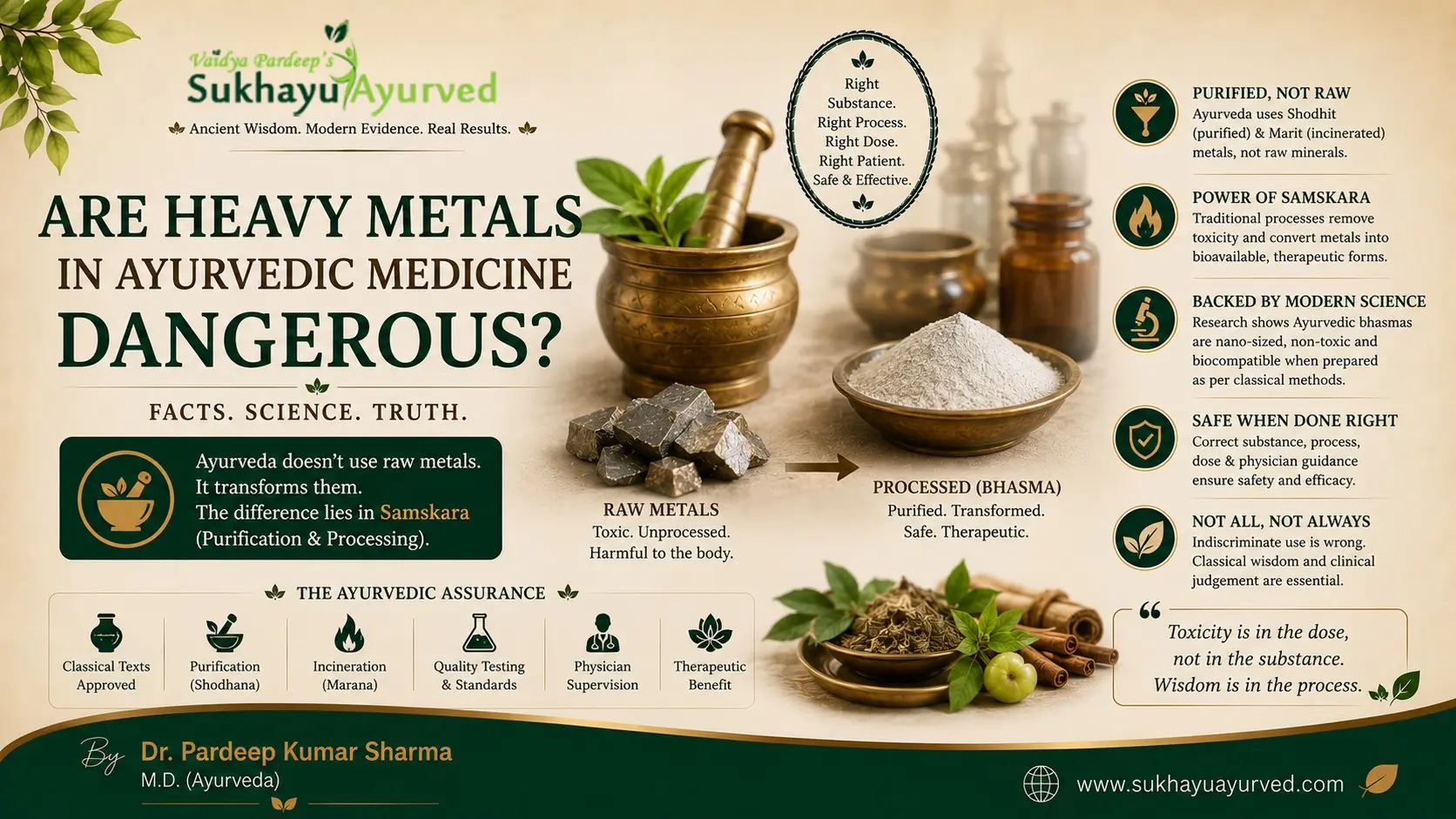
A properly prepared bhasma is not raw mercury or lead simply crushed into a fine powder. It goes through shodhana (purification) and marana (repeated incineration), through a defined number of putas, and it is classically judged "properly made" only when it passes tests such as nishchandratva and rekhapurnatva. The more scientifically defensible reading of that process is this: it converts reactive or soluble forms of the metal into a comparatively stable, poorly soluble mineral matrix — in mercury's case, a mercury sulphide phase.
That transformation can change a great deal:
- the chemical compound itself
- the crystal structure
- the particle size and morphology
- the surface chemistry
- how readily it dissolves in gastrointestinal fluids
- how much of it actually enters the bloodstream
So the correct thing to say is that bhasmikarana may turn a readily reactive metal into a comparatively stable, less bioaccessible mineral compound — and this can reduce how much the body is actually exposed to.
But here is where I part company with anyone who wants to end the sentence there. It does not abolish the underlying toxicological concern. The metal atom is still present. What has changed is how tightly it is held, how readily it dissolves, and how much reaches living tissue. That is a real and meaningful difference — but it is a difference in bioavailability, not a magic exemption from the laws of toxicology.
The most academically honest formulation I can offer is this: the toxicological behaviour of a bhasma cannot be inferred from its total elemental metal content alone. Classical processing can convert elemental metals into chemically distinct, poorly soluble crystalline phases with reduced gastrointestinal bioaccessibility. Yet residual absorption, cumulative exposure over time, particle-mediated effects, and variability between manufacturers all remain relevant. Which is exactly why formulation-specific handling, correct dosing, and clinical monitoring are not optional extras — they are the safety mechanism itself.
Many toxicity studies have been carried out on mercury-based preparations, and I am not aware of these properly prepared, properly dosed preparations turning out to be harmful to human health in that setting. But I do not want to hide behind research to make the point. The point stands on its own logic: identity of the compound, pharmaceutical processing, dose, duration, quality control, and clinical supervision — that is what determines safety. Not the mere line "it contains lead or mercury."
Where the real danger actually lies
If you take one thing from this article, take this: when a medicine is not titrated for the correct dose and is taken blindly, it hardly matters which system of medicine it came from — it can become toxic. That is as true of a pharmaceutical drug as it is of a rasa preparation.
This is why I am cautious about handing anyone a tidy "watch for these five symptoms" checklist. It would be false precision. The warning signs are not the same across medicines. A mercury-based preparation does not behave like a copper-based one. Some metal-containing medicines can raise blood pressure and little else; others may show up as discolouration of the skin or of the palms and soles. And it varies from patient to patient. There is no single narrative that covers them all.
That variability is the argument. It is precisely because the risks are compound-specific and person-specific that these medicines are not something to self-prescribe. The genuine hazard is not "Ayurveda uses metals." The genuine hazard is a rasa preparation bought over a counter or online, taken without a qualified physician, without correct dosing, without anyone watching for the specific response that particular compound can produce in that particular body.
What responsible supervision looks like
I will tell you what we actually do, so you have something concrete rather than reassurance.
We procure our medicines from GMP-certified pharmacies, and we obtain TLC and heavy-metal reports for those medicines from the pharmacies. That is a documented quality-control layer sitting alongside the classical preparation and the clinical judgement — not a slogan.
And for supervision over time: where a metal-containing medicine continues for more than three months, we obtain periodic heavy-metal blood levels along with liver and kidney function tests (LFT/KFT) every three months. So far, across that monitoring, no abnormalities have shown up in the reports. That is not a promise about every future case — it is a description of how the safety net is meant to work, and what it has shown in practice.
The larger point
There is a real difference between knowledge and information. We live in a time where a strong reliance on fragments of information has quietly eroded the depth of actual knowledge — and this is true across every science, not only this one. A single scan of a single product becomes a headline becomes a fear, without anyone asking which class of medicine it was, whether it was processed, whether it was dosed, whether anyone was supervising.
Heavy metals in Ayurvedic medicine are neither the harmless non-issue some enthusiasts claim, nor the silent poisoning the scare stories imply. They are a genuine subject that demands genuine seriousness: the right compound, properly processed, correctly dosed, quality-checked, and clinically monitored. Handled that way, it is medicine. Handled carelessly, by anyone in any system, it is not.
If you are worried about a medicine you are taking, or one you are considering, the answer is not to panic and it is not to trust blindly. It is to ask a qualified physician exactly these questions — and to expect a straight answer.
This article is for educational purposes and reflects clinical experience in Ayurvedic practice. It is not a substitute for individualized medical evaluation. Ayurvedic management is intended to complement, not replace, conventional diagnosis and care — and metal-containing preparations in particular should only be taken under the supervision of a qualified physician, with appropriate dosing and monitoring. Please consult a qualified physician for assessment specific to your case.
To discuss a specific medicine or treatment plan, you can book a consultation with Dr. Pardeep Sharma at Sukhayu Ayurved: