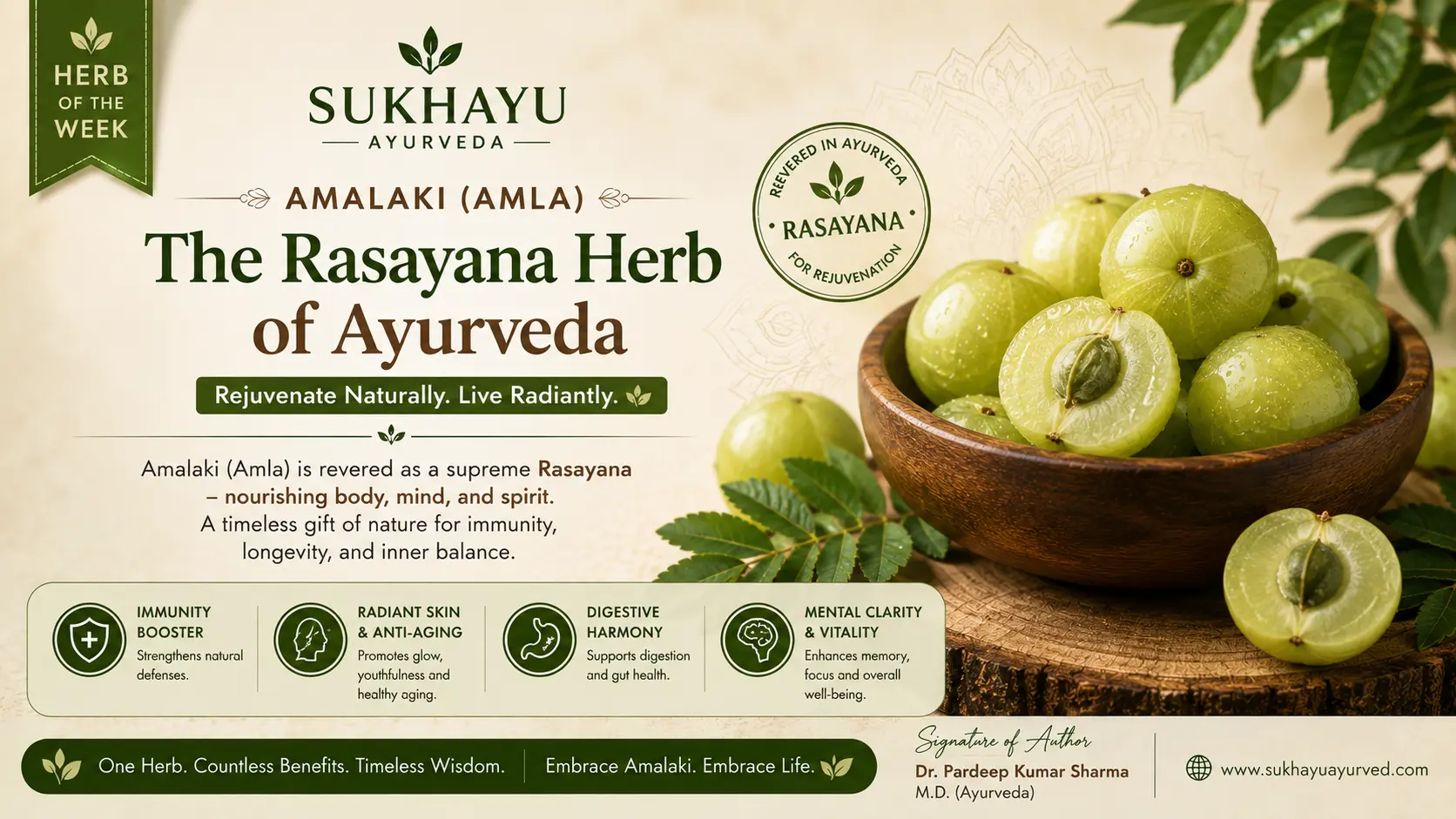
There is a strange thing that happens when a whole civilisation decides it already understands something. It stops looking. Amla is the clearest example I know. Ask almost anyone in India what amla is good for, and the answer arrives before you finish the question: vitamin C. It is the one fact everyone is certain of. And it is precisely that certainty — not ignorance, but confidence in the wrong thing — that stands between most people and the fruit they think they know.
Consider the order of events. Ayurveda worked with Amalaki for a very long time before anyone had heard the word ascorbic acid. The chemistry was isolated and named comparatively recently — decades ago, not millennia. Which means the tradition that actually understood this fruit reached its full clinical maturity without ever once thinking about vitamin C, because vitamin C had not been discovered. To turn around now and explain a whole-fruit tradition by a single constituent found much later — and then to sell that constituent back to people as the point of the fruit — is to read the story backwards. The molecule is real. But it is a footnote that got promoted to the title.
This is not a small correction. It changes what you do with the fruit sitting in your kitchen.
What Rasayana actually is — and what it is not
To use Amalaki correctly you first have to understand the word that always travels with it: Rasayana. It is one of the most abused words in modern wellness vocabulary, flattened into "anti-ageing supplement" or "immunity booster," which is roughly like translating surgery as sharp objects. Both involve a blade. Neither definition survives contact with the person who actually does the work.
Charaka is precise about this in a way the marketing is not. In the opening of his Rasayana section he divides all of bheshaja — therapeutics itself — into two arms:
स्वस्थस्योर्जस्करं यत्तु तद्वृष्यं तद्रसायनम्। प्रायः, प्रायेण रोगाणां द्वितीयं प्रशमे मतम्॥
One arm, svasthasya urjaskaram — that which builds strength and vitality in the person who is already well. The other arm, the one that "mostly" (प्रायेण) works toward prashama, the pacification of disease in the person who is afflicted. Rasayana and Vajikarana sit in the first arm; the vast machinery of disease-treatment sits in the second.
Now read the single word Charaka plants in that verse and never lets go of: प्रायः — prayah, "mostly," "generally." He is warning you, in advance, that neither arm is absolute. And his great commentator Chakrapani makes the warning explicit. The same substance, he says, can occupy either category depending entirely on the clinical context it is used in. Agastya Haritaki is called a Rasayana in the treatment of kasa (cough). Yogaraja is called a Rasayana in pandu (anaemia). The ghrita-and-guda preparations are Rasayana in kshataksheena (wasting from chest injury). None of these is a shelf-stable "youth tonic." Each is a Rasayana because of the role it plays inside a specific clinical situation.
That is the definition that matters, and it is the opposite of the supplement-aisle version. Rasayana is not a category of products. It is a functional role a substance performs inside a clinical context. You do not "take a Rasayana" the way you take a multivitamin. A physician deploys something as Rasayana, for this person, for this reason, at this point in their treatment. (I have written at more length about this on our Rasayana page, because it is the single most misunderstood idea in the whole field.)
And then there is the second word, the one that gets mistranslated even more dangerously: Vayasthapana. Charaka names Amalaki in his Vayasthapana Dashemani — the ten substances that stabilise the stage of life. The word comes from vayah tarunam sthapayati — it establishes, it holds, the current phase. It does not rewind. It does not reverse. It does not "turn back the clock," which is exactly the promise printed on the amla-candy packet. Establishing and reversing are not the same verb, and the entire anti-ageing marketing of amla is built on quietly swapping one for the other.
The bridge between two fruits
There is a detail in Charaka that tells you almost everything about how classical Ayurveda actually thinks — and it happens to involve Amalaki directly. After describing Haritaki at length across many verses (its five tastes, its power over a long list of conditions), Charaka turns to Amalaki and says something remarkable:
तान् गुणांस्तानि कर्माणि विद्यादामलकीष्वपि। यान्युक्तानि हरीतक्या वीर्यस्य तु विपर्ययः॥
Understand that Amalaki carries the same gunas and the same karmas as Haritaki — with one reversal: the veerya is opposite. Haritaki is ushna (heating). Amalaki is sheeta (cooling). Same actions. Opposite thermal nature. Both are then called amrita-kalpa — nectar-like — by virtue of their karma, in their prepared forms, not as raw fruit chewed off a branch.
Sit with what that means clinically. Two fruits that share almost their entire pharmacological profile behave differently in the body for one reason — their veerya runs in opposite directions. This is why, in Triphala, when Amalaki stands in equal ratio with Haritaki and Bibhitaki, the whole behaves differently again from any of the three alone. The action of a substance in Ayurveda is never a fixed property you can read off a label. It is shaped by samskara (processing) and sanyoga (combination) and context. The vitamin-C model cannot see any of this, because a milligram of ascorbic acid is a milligram of ascorbic acid whether it comes hot or cold, alone or in ratio. The whole reason the classical system is powerful is the reason the reductive model is blind.
Where Amalaki actually earns its place in the OPD
Let me be concrete, and let me also be careful, because single-herb thinking is exactly the trap this article exists to close. Amalaki does not "treat" anything by itself. It earns its place as a component — of a preparation, inside a protocol that also includes diet, oral medicines, procedures, and the right anupana.
Where I reach for it most readily is in Pitta-dominant conditions — and here the veerya-viparyaya point stops being academic and becomes the reason for the choice. When the clinical picture is hot — inflammatory skin disease, a Pitta-driven burnout where the person is running on a depleted, overheated system — the cold fruit is the one that belongs there. This is where Amalaki-containing preparations do real work as part of the management of Pitta-driven skin disease and the broader family of autoimmune conditions, where the disturbance is systemic and tridoshic with Pitta prominent — never a single dosha, never a single herb.
Chyawanprash — of which Amalaki is the base — earns its place in a very different room. In certain neurological presentations, in degenerative pictures like cerebellar atrophy and the ataxias, the preparation as a whole has a role within a much larger protocol. Not "amla for the brain." The lehya, made correctly, deployed inside a treatment plan. And Dhatri Rasayana enters where the requirement is to rebuild tissue in states of emaciation and kshaya.
Notice that these are three different clinical jobs done by three different preparations that happen to share a fruit. The amla in a gummy and the Amalaki in Chyawanprash prescribed for a degenerative condition share a botanical origin and almost nothing else that matters. That is the whole argument, stated as a clinical fact.
Why the fruit becomes something the juice can never be
Here is the part that the "I already eat amla" crowd has never been told. It is not about the herb. It is about the samskara.
Take Amalaki Rasayana, the classical preparation. It is not amla powder in a jar. It is the fruit subjected to bhavana — trituration — with its own svarasa (fresh juice), and not once, but many times over. When you process the parthiva part (the churna, the earth-dominant powder) with the jaliya part (the svarasa, the water-dominant juice) again and again, two concrete things happen.
First, fortification. Each cycle re-saturates the substrate with the fruit's own active fraction and dries it back in. You are loading the same dravya's own potency into itself, cycle after cycle, until the finished preparation holds a concentration and character the raw fruit simply cannot. Second, the particle size reduces with each round of trituration, so absorption increases. The substance becomes finer, more sukshma — able to travel and act where a coarse powder or a glass of juice never reaches.
This is why samskara is not a synonym for "processing." Processing, in the industrial sense, means adding foreign things, extracting one molecule, sweetening the result for the shelf. Samskara means the transformation of a substance's quality through its own nature — the same fruit, its own juice, many times, becoming something categorically different. Modern investigation has, separately and by its own methods, noticed this same non-equivalence between the raw fruit and the properly-made preparation: in a randomised human study, Amalaki Rasayana prepared fresh strictly according to the traditional text was found to maintain and enhance DNA strand-break repair in healthy aged individuals, with no adverse effects.¹ I offer that only as a parallel observation from another discipline — not as the reason bhavana works. The classical logic stood on its own for a very long time before anyone had a comet assay. Let the science remain science.
The line no one wants to hear: food is not medicine
So then people ask the obvious question — "fine, so how should I be using amla?" — and expect me to hand them a daily ritual. I won't, because the honest answer disappoints the wellness instinct.
Draw a hard line between ahara (food) and aushadha (medicine). The simplest way to hold it: food is what you eat every day; medicine is deliberately limited. Amalaki is, most of the time, a medicine. Its legitimate role as food is narrow and seasonal — a pickle for a while when the fruit is in season, its amla rasa (sourness) used as a natural souring agent in cooking. That is food. That is fine. It is also not a Rasayana, and it was never meant to carry the weight the internet puts on it.
Everything above that line belongs in a clinic. Which brings us to the specific modern absurdity: the YouTube "homemade Chyawanprash." What people cook up from a video is not Chyawanprash — it lacks the dravyas, the proportions, the samskara, the entire process — and yet it gets eaten daily, in quantity, as a health habit. Here is the quiet indictment. Even real Chyawanprash, taken every day out of habit by the wrong person, often ends up doing little more than acting as a mild laxative for them. And if a genuine Rasayana preparation has been reduced, in your body, to a bowel movement — you were never using it as a Rasayana at all. The wrong use wastes even the right preparation. That is how far the misunderstanding runs.
The demarcation we lost
Step back and the real problem comes into view. We have lost the line between the herbal and the Ayurvedic. The vitamin-C tablet, the effervescent "immunity" fizz, the gummy, the cold-pressed juice — these are the herbal side of amla. They are not wrong so much as they are aimed at a different target entirely. They chase a molecule. Ayurveda was never chasing a molecule. It was building Ojas — and Ojas cannot be extracted, dosed into a capsule, or bottled in an effervescent tablet. The thing the tradition actually valued in this fruit is not the sort of thing the extraction model can even see, let alone sell.
Here is the proof of the lost demarcation, and it is a strange absence once you notice it. We make a proper khanda for Haridra. We make one for Shatavari. We make classical preparations for Krauncha. But where is the Amalaki khanda-paka — the sugar-or-jaggery-based classical preparation that would have carried this fruit's tangy amla-rasa into something both genuinely palatable and pharmacologically coherent? It would have had every commercial advantage the gummies grabbed for — the taste, the shelf appeal — while remaining actual Ayurveda. The market reached for the fizzy tablet instead and left the classical form on the table. That is not a gap in the tradition. It is a gap in us.
Ayurveda looks at the broad picture. The extract looks through a slit. You can build a supplement industry on the slit, and we have. But you cannot build health on it, and you certainly cannot understand a fruit through it.
You have amla at home. The correction is not to eat more of it. The correction is to stop mistaking the fruit for the tablet, the food for the medicine, and the herbal for the Ayurvedic — and to let a preparation like Amalaki Rasayana be what it actually is: a made thing, deployed for a reason, by someone trained to judge the reason.
Cure is divine. Treatment is possible.
Dr. Pardeep Sharma, M.D. (Ayurveda) is the founder of Sukhayu Ayurved, Jaipur. With over 20 years of clinical experience in Ayurvedic management of orthopedic, neurological and autoimmune conditions.
To discuss whether a Rasayana protocol has any place in your specific condition, book a consultation at sukhayuayurved.com/book-appointment. WhatsApp: 9050802060 · [email protected]
Medical disclaimer: This article is for educational purposes only and is not a substitute for individual medical advice, diagnosis, or treatment. Classical Rasayana preparations such as Amalaki Rasayana and Chyawanprash are physician-judged interventions, not self-prescribed supplements. Do not begin, stop, or alter any treatment based on this article. Always consult a qualified physician regarding your specific condition.
¹ Vishwanatha U, Guruprasad KP, Gopinath PM, et al. Effect of Amalaki rasayana on DNA damage and repair in randomized aged human individuals. Journal of Ethnopharmacology. 2016;191:387–397. PMID: 27364038. DOI: 10.1016/j.jep.2016.06.062.